


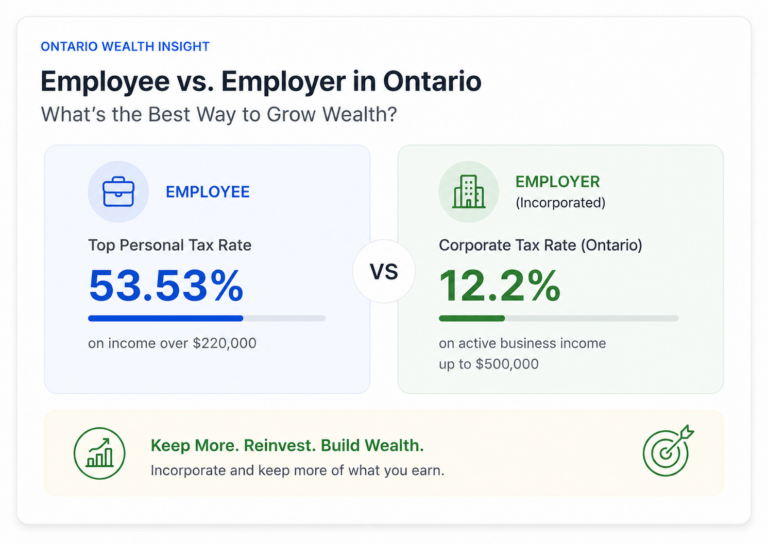
The fastest legal way to grow wealth in Ontario is to stop earning solely as an employee and start earning through an incorporated business, because a corporation is taxed at roughly 12.2% on active business income up to $500,000, versus a personal marginal tax rate that climbs as high as 53.53%. That gap lets you reinvest capital that would otherwise go to the Canada Revenue Agency. It isn’t the only path to wealth, and it isn’t right for everyone at every income level – but for Ontario entrepreneurs generating consistent profit, it’s the single biggest lever available.
This article breaks down exactly why that gap exists, when incorporating actually pays off, and how to incorporate in Ontario yourself without overpaying for the privilege.
Why Does Being an Employee Cap Your Wealth-Building Speed?
As an employee, every dollar you earn is taxed at your personal marginal rate the moment it hits your paycheque. In Ontario, combined federal and provincial personal tax rates reach 53.53% on income over roughly $246,752 (2025 threshold), and you hit rates above 40% well before that.
There’s no deferral mechanism. You can’t leave money “inside” your employment to be taxed later at a lower rate. Your only wealth-building tools are RRSPs, TFSAs, and whatever you can save after-tax – useful, but limited by annual contribution room.
An incorporated business owner has a third option employees don’t: leave profit inside the corporation, pay the low small business tax rate on it, and reinvest what’s left. That’s the mechanism behind almost every “incorporate to save tax” conversation you’ll hear from an accountant.
How Does Incorporating Actually Save Money? The Core Mechanism
When you incorporate in Ontario, your business becomes a separate legal person under the Ontario Business Corporations Act (OBCA). That separation is what unlocks the tax advantage.
Ontario corporations pay a combined federal-provincial small business tax rate of about 12.2% on the first $500,000 of active business income each year – 9% federal small business rate plus roughly 3.2% Ontario small business rate. Compare that to personal rates reaching over 53%, and the incentive is obvious.
The catch: this only works on income you leave inside the corporation. If you pull every dollar out as salary or dividends to fund your lifestyle, you’re back to paying personal tax rates on it – you’ve just added corporate compliance costs on top. The advantage is a deferral and reinvestment tool, not a tax elimination trick.
Original insight from working with Ontario founders: most first-time incorporators assume the tax savings appear on their personal return immediately. They don’t. The savings sit in retained earnings inside the corporation, available to reinvest in equipment, marketing, hiring, or investments, which is exactly why incorporating tends to accelerate business growth faster than it accelerates personal net worth in year one. If you need the cash personally right away, the corporate structure buys you very little.
Employee vs. Incorporated Owner: Side-by-Side Comparison
| Factor | Employee | Incorporated Business Owner |
|---|---|---|
| Top marginal tax rate | Up to 53.53% (Ontario, 2025) | ~12.2% on first $500,000 active business income |
| Income splitting with family | Not available | Possible via dividends (subject to CRA's Tax on Split Income rules) |
| Liability exposure | None (employer bears it) | Limited to corporate assets, not personal |
| Ability to retain/reinvest pre-tax profit | No | Yes, inside the corporation |
| CPP/EI contributions | Mandatory, employer-matched | Optional, depending on how you pay yourself |
| Startup cost | $0 | ~$300–$400 (DIY) to $2,000–$5,000+ (with a lawyer) |
| Annual compliance | T4 slip only | T2 corporate return, annual return, minute book |
| Benefits (health, pension, EI) | Employer-provided | Must self-fund or structure through the corp |
Neither column is universally “better.” An employee with strong benefits and no interest in running a business may build wealth just fine through RRSPs, employer matching, and disciplined investing. Incorporation is the better lever specifically when you’re generating business profit beyond what you need to live on.
When Does It Actually Make Sense to Incorporate in Ontario?
Most Ontario accountants point to a rough threshold: once your business nets around $50,000+ in annual profit , the tax deferral typically outweighs the added accounting and compliance cost. Below that, the roughly $1,500–$2,500 a year you’ll spend on a T2 return and bookkeeping can eat into the benefit.
A few concrete signals it’s time:
- You’re consistently leaving profit in the business rather than needing every dollar to live on.
- You want liability protection because the business carries risk (contracts, client work, physical premises).
- You plan to bring on investors or partners, which requires a formal share structure.
- You want income-splitting options with a spouse or adult family members through dividends.
- You’re building toward a sale, and the Lifetime Capital Gains Exemption on qualifying small business shares (over $1.25 million as of 2024 federal changes) becomes relevant.
If none of these apply yet, staying a sole proprietor or employee a little longer is completely reasonable - incorporation is a tool, not a status symbol.
How Do You Incorporate a Business in Ontario Online? Step-by-Step
Ontario runs incorporation through the Ontario Business Registry (OBR), a government platform launched October 19, 2021 that replaced the old paper-based system and now handles over 90 types of filings, including incorporations, name registrations, and annual returns. The system is a bit complicated, so we advise you to use a trusted incorporation agency like Biz Ontario, that will simplify the registration for you and do all the mandatory filings in one package.
Biz Ontario specializes in Ontario business incorporation and registration services. Our knowledge covers Ontario corporations, federal corporations, sole proprietorships, trade names, partnerships, professional corporations, company keys, annual returns, CRA program accounts, and business compliance requirements. We continuously monitor regulatory updates and registration procedures to provide accurate and up-to-date information that helps business owners make informed decisions. More than 5,000 businesses have been successfully registered through Biz Ontario, with new registrations added every day.
- Choose named or numbered. A numbered corporation (e.g., 1234567 Ontario Inc.) skips the name search step entirely. A named corporation requires proof that the name is unique.
- Order a NUANS report if going named. NUANS (Newly Upgraded Automated Name Search) report costs roughly $50–$100 from a third-party provider and is valid for 90 days.
- Set up your Ontario Business Registry profile using a One-key account or Ontario.ca account. You’ll receive a company key by email – store it securely, since it’s required for every future filing.
- File your Articles of Incorporation in Ontario through the registry: corporate name, share structure, director information, and registered office address.
- Pay the $300 government filing fee online by credit card. This is the actual “cost to incorporate in Ontario online” – everything else is an optional add-on.
- Receive your Certificate of Incorporation, typically by email within minutes to a few business days.
- Register for a CRA Business Number. The OBR can generate this automatically during filing if you opt in; otherwise, you’ll need to register separately at canada.ca.
- Set up a minute book and initial bylaws. Skipping this is the most common regret among self-incorporated founders – a clean minute book matters the moment a bank, investor, or the CRA asks for it.
What’s the Cheapest Way to Incorporate in Ontario?
If you file it yourself, the cheapest way to incorporate in Ontario breaks down to:
- $300 – Ontario Business Registry filing fee (mandatory, non-negotiable)
- $0–$80 – NUANS name search (skip entirely by choosing a numbered corporation)
- $0 – CRA Business Number registration (free if you opt in during OBR filing)
That puts a true DIY incorporation at roughly $300–$400 all-in, done in about an hour if you have your director and share information ready. Hiring a lawyer or incorporation service typically runs $1,500–$5,000+ once you add customized share structures, shareholder agreements, and professional advice – worth it for complex ownership situations, unnecessary for a simple single-owner startup.
Federal incorporation through Corporations Canada costs $200 online, technically cheaper – but if you operate primarily in Ontario, you’ll still need to file an extra-provincial registration here, which narrows the price gap and adds a layer of paperwork most local small businesses don’t need.
Registering a Corporation in Ontario vs. Registering a Business Name: What’s the Difference?
People often use “register a corporation in Ontario” and “register a business name” interchangeably. They’re not the same thing.
- Registering a business name (Master Business Licence) costs $60, applies to sole proprietorships and partnerships, and does not create a separate legal entity or offer liability protection. It expires every five years.
- Registering a corporation creates a distinct legal entity under the OBCA, offers liability protection, and unlocks the small business tax rate. It has no expiry but requires ongoing filings, including a $12/year Ontario annual return.
If your goal is wealth-building through tax deferral and liability protection, a business name registration alone won’t get you there – you need actual incorporation.
Frequently Asked Questions
How long does it take to incorporate a business in Ontario online?
Online filings through the Ontario Business Registry are usually processed within minutes to a few business days. Paper filings can take two to four weeks.
Do I need a lawyer to incorporate in Ontario?
No. A lawyer isn't legally required, and many single-owner businesses incorporate themselves through the Ontario Business Registry for around $300–$400. A lawyer becomes worthwhile for complex share structures, multiple founders, or partner buyouts.
What's the difference between provincial and federal incorporation in Ontario?
Provincial (OBCA) incorporation costs $300 and only protects your name within Ontario. Federal incorporation costs $200 through Corporations Canada and provides national corporate name protection, but requires extra-provincial registration if you operate in Ontario, adding cost and another filing to track.
Does incorporating automatically register me with the CRA?
Not automatically — you have to opt in. The Ontario Business Registry offers integrated CRA Business Number registration during your incorporation filing. If you skip it, you'll need to register separately through the CRA.
Is incorporating always the best way to grow wealth in Ontario?
Not always. Incorporation can be particularly beneficial once your business consistently earns more profit than you need to withdraw personally, with roughly $50,000 or more in annual net profit often used as a general rule of thumb. Below that level, compliance costs such as T2 corporate tax returns, bookkeeping, and annual filings can sometimes outweigh the potential tax-deferral benefit.