


A sole proprietorship in Ontario is the cheapest and fastest way to legally operate as a freelancer, but it comes with unlimited personal liability and no tax-rate advantage as your income grows. The pros are low cost, simple taxes, and minimal paperwork. The cons are personal exposure to business debts, no liability shield, and a self-employment tax bill that lands all at once each spring. For most freelancers earning under roughly $75,000–$80,000 in net profit, it’s the right starting structure – but it’s worth knowing exactly what you’re trading away.
I’ve walked dozens of Ontario freelancers through this decision, and the pattern is consistent: people either register a sole proprietorship without understanding the liability tradeoff, or they overthink incorporation before they have the revenue to justify it. This guide covers both sides plainly.
What Is a Sole Proprietorship in Ontario?
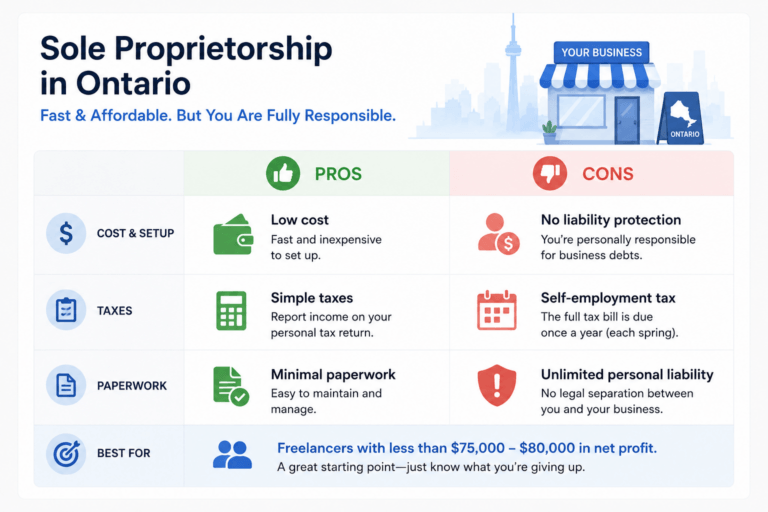
A sole proprietorship is a business owned and run by one person, where you and the business are legally the same entity. There’s no separation between your personal assets and your business assets – everything sits under your own name for legal and tax purposes.
You report business income directly on your personal T1 tax return. There’s no separate corporate tax filing, no minute book, and no annual corporate return.
If you operate strictly under your own legal name (e.g., “Jane Smith,” not “Jane Smith Design”), you technically don’t need to register anything with the province. The moment you use any other operating name, registration becomes mandatory.
✅ Pros of a Sole Proprietorship for Freelancers
Low Startup Cost
Business name registration costs only $60 through the Ontario Business Registry, compared with approximately $300 for provincial incorporation.
Simple Taxes
Business income is reported directly on your personal T1 Tax Return using Form T2125, eliminating the need for a separate T2 corporate return.
Fast Setup
Online registration is usually processed immediately, allowing you to receive your Business Identification Number (BIN) the same day.
Complete Control
You make every business decision, keep all after-tax profits, and avoid corporate formalities such as board meetings, shareholder resolutions, and annual corporate records.
Easy to Close
If you stop freelancing, you can simply cancel your registration or allow it to expire. Unlike a corporation, there is generally no formal dissolution process.
A sole proprietorship is often the ideal starting point for freelancers because it combines low startup costs, simple tax reporting, minimal paperwork, complete decision-making authority, and an easy exit if your business plans change. As your income grows or your liability risks increase, you can always incorporate later.
Cons of a Sole Proprietorship for Freelancers
Unlimited personal liability – This is the big one. If a client sues you, or the business can’t pay a debt, your personal assets – your car, your savings, potentially your home – are on the line. There’s no legal wall between you and the business.
No corporate tax rate – Ontario’s small-business corporate tax rate sits around 12.2% on the first $500,000 of active business income for an incorporated business. As a sole proprietor, your business income is taxed at your full personal marginal rate, which climbs well above that once your income rises.
Harder to raise money or bring on partners – Investors and lenders generally prefer dealing with a corporation. A sole proprietorship also can’t issue shares, so it’s a dead end if you ever want equity partners.
Less credibility with larger clients – Some corporate clients and government contracts require vendors to be incorporated, or at minimum treat an incorporated vendor as lower-risk.
CPP contributions on both sides – As a self-employed person, you pay both the employee and employer portions of Canada Pension Plan contributions on your net business income, which increases your effective tax burden compared to a salaried employee.
Sole Proprietorship vs. Incorporation: Quick Comparison
| Factor | Sole Proprietorship | Ontario Corporation |
|---|---|---|
| Government registration fee | $60 | $300 (provincial) / $200 (federal) |
| Validity / renewal | 5 years, renew for $60 | Ongoing, annual return required |
| Liability | Unlimited — personal assets exposed | Limited to corporate assets |
| Tax return | Personal T1 (T2125 form) | Separate T2 corporate return |
| Tax rate on profit | Personal marginal rate | ~12.2% small-business rate (Ontario, first $500,000) |
| Setup speed | Same-day online | Same-day to ~5 business days |
| Ongoing admin | Minimal | Minute book, annual return, corporate filings |
| Best for | Early-stage freelancers, lower income | Growing income, liability-sensitive work |
How Do You Register a Sole Proprietorship in Ontario?
- Search the Ontario Business Registry at ontario.ca/businessregistry to confirm your chosen operating name isn’t already in obvious use. Ontario doesn’t guarantee exclusive name rights for sole proprietorships, but a distinct name avoids confusion.
- Create or log into an Ontario.ca account and verify your identity.
- Select “Register a Business Name” and enter your name, address, and business activity details.
- Pay the $60 government fee by credit card online.
- Receive your Master Business Licence (MBL) instantly, which includes your Business Identification Number (BIN) and expiry date.
- Apply for a federal Business Number (BN) through the CRA separately, using your provincial BIN – you’ll need this for GST/HST, payroll, or import/export accounts.
Should You Register the Sole Proprietorship Yourself or Use a Filing Agent?
Registering a sole proprietorship in Ontario is a process many entrepreneurs can complete themselves. However, small mistakes—such as choosing a conflicting business name, entering incorrect information, or selecting the wrong registration option—can result in delays or rejected filings.
Register It Yourself
- Lowest overall cost
- Complete the filing at your own pace
- Suitable for simple registrations
- You'll handle the name search and application yourself
Use Biz Ontario
- Professional review before submission
- Business name search assistance
- Registration completed in as little as 1 business hour
- Support throughout the filing process
Biz Ontario has helped register more than 5,000 businesses across Ontario. If you'd rather avoid paperwork and reduce the risk of filing errors, our experienced filing agents can handle your sole proprietorship registration from start to finish, allowing you to focus on launching your business with confidence.
How Much Does an Ontario Sole Proprietorship Cost?
The core government fee is $60 for a five-year registration. Beyond that, most freelancers have no mandatory ongoing provincial cost until renewal.
Real costs that add up beyond the $60 filing fee:
- HST Registration – mandatory once your revenue exceeds $30,000 across any four consecutive calendar quarters
- Accounting or bookkeeping software – optional but common, roughly $20–$50/month
- Business insurance (e.g., professional liability) – recommended given the unlimited-liability exposure; cost varies by field
- Municipal business licence, if your municipality or industry requires one – separate from provincial registration
How Does Ontario Sole Proprietorship Renewal Work?
Registration is valid for five years from the date you register, not five years from a calendar date. ServiceOntario typically sends a renewal notice approximately 90 days before expiry.
Renewal costs the same $60 fee as the original registration. If you let it lapse, someone else could register the same name, so it’s worth renewing promptly rather than waiting until the exact expiry date.
When Should a Freelancer Consider Incorporating Instead?
Tetiana Diordytsia, marketing specialist at Biz Ontario notes that the switch usually makes financial sense once net profit is consistently landing above roughly $75,000–$80,000 a year, because that’s typically where the gap between the personal marginal rate and Ontario’s small-business corporate rate starts outweighing the added cost of corporate accounting and filings.
The other trigger is risk exposure – freelancers doing high-liability work (contracting, consulting with large financial exposure, anything with real injury or damage risk) often incorporate earlier than the income math alone would suggest, simply to protect personal assets.
Frequently Asked Questions
Do I have to register a sole proprietorship in Ontario if I freelance under my own name?
No. If you operate strictly under your exact legal name with no additional words, you're not required to register with the Ontario Business Registry. The moment you add any brand name or descriptor, registration becomes mandatory.
How much does it cost to register a sole proprietorship in Ontario?
The government fee is $60 for a five-year registration through the Ontario Business Registry. This is separate from any CRA Business Number application, HST registration, or municipal licensing costs.
When do I need to register for HST as an Ontario freelancer?
You must register for HST once your total taxable revenue exceeds $30,000 across any four consecutive calendar quarters. Below that threshold, HST registration is optional.
How long does an Ontario sole proprietorship registration last?
Five years from the date of registration. ServiceOntario sends a renewal reminder around 90 days before expiry, and renewal costs the same $60 government fee.
Is a sole proprietorship riskier than incorporating in Ontario?
Yes, in terms of liability. As a sole proprietor, you and the business are the same legal entity, so personal assets can be used to satisfy business debts or legal judgments. Incorporation creates a separate legal entity that limits that exposure.