


Yes. In Ontario, two businesses can legally register and operate under the same or a very similar name, because registering a business name is no guarantee of exclusive use – business name protection is provided by a trademark, not by name registration, and the Business Names Act does not prohibit the registration of identical names. This surprises a lot of new entrepreneurs, who assume that filing a name with the province locks it down the way a domain registration does. It doesn’t.
Where it gets more complicated is incorporation. If you’re incorporating under a word name rather than a numbered name, Ontario does apply a stricter test – but even then, the province checks for confusion, not just an exact match.
What’s the Difference Between Registering a Trade Name and Protecting It?
This is the single most misunderstood part of Ontario business registration, so it’s worth separating clearly.
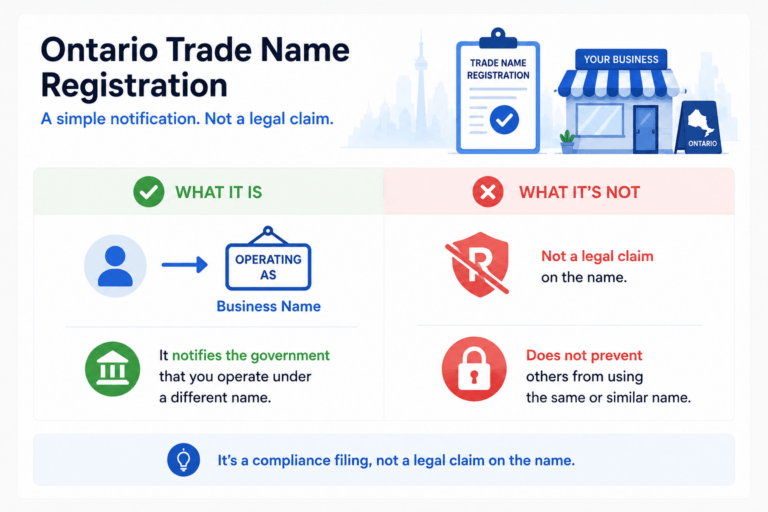
Registering an Ontario trade name simply notifies the government that you’re operating under a name other than your own legal name (for a sole proprietor) or a name other than your corporation’s registered name (for a “doing business as” or operating name). It’s a compliance filing, not a legal claim on the name.
Protecting a name – actually stopping someone else from using it – comes from trademark law, or from proving that a competitor’s use of a similar name is causing confusion or damages under the Business Names Act.
I’ve seen this trip up first-time founders constantly: a client registers “Maple Leaf Bookkeeping” as a sole proprietorship, feels secure, and six months later finds three other unrelated firms using near-identical names in the same city. The registration was valid. It just never gave them exclusivity.
Is Ontario Business Name Registration Different for a Corporation?
Yes, and this is where the rules tighten. When you incorporate under a word name in Ontario, a NUANS search examines all corporate, business and Ontario trade names across the province, and generates a report that reserves your proposed name in its database for 90 days.
For the purposes of registering a business name, the Ontario government does not concern itself with whether your name is confusing, only with whether it’s identical to an existing name. But Ontario law itself requires that you can’t use a name that would cause confusion with an existing name – and enforcing that distinction falls to the courts, not to the registry clerk processing your filing.
The NUANS report has to be “Ontario-biased,” meaning Ontario companies with similar names in similar lines of business are ranked higher, which is why Ontario will not accept a NUANS report generated with another province’s bias. If you skip incorporating under a word name and instead take a numbered name (like 123456789 Ontario Inc.), you don’t need a NUANS search or report at all, since the Companies and Personal Property Security Branch assigns the number directly.
Ontario Business Name Registration for a Corporation vs. Sole Proprietorship
| Feature | Salary | Dividends |
|---|---|---|
| Tax deducted at source | Yes (payroll withholding) | No |
| Creates RRSP contribution room | Yes | No |
| CPP contributions required | Yes (employer + employee portions) | No |
| Reduces corporate taxable income | Yes | No (paid from after-tax profit) |
| Payroll account with CRA needed | Yes | No |
| Easier for mortgage/loan applications | Generally yes (T4 income) | Can be harder to document |
| Admin complexity | Higher (payroll filings) | Lower |
What Happens if Someone Else Uses My Name?
If another business uses your name – or one deceptively similar to it – and you can show it caused you real harm, you have a legal remedy. The Business Names Act provides for payment of minimum compensation of $500 if damages are proven, on top of whatever actual damages the court awards.
That $500 floor is a statutory backstop, not a ceiling. In practice, most disputes I’ve watched play out get resolved long before a courtroom – usually with a cease-and-desist letter once one party discovers the other has registered federal or provincial trademark rights the plain Ontario trade name filing never gave them.
Tetiana Diordytsia, marketing specialist at Biz Ontario, puts it plainly: registering your Ontario trade name protects your ability to legally invoice, open a business bank account, and operate under that name – it does not protect your brand. Those are two entirely different legal questions, and conflating them is the most expensive mistake founders make in their first year.
📋 How Do You Register an Ontario Trade Name?
Registering an Ontario trade name is a straightforward online process through the Ontario Business Registry. Follow these steps to complete your registration correctly.
Select your proposed trade name and determine whether you're registering it for a sole proprietorship, partnership, or as an operating name for an existing corporation.
Although not mandatory, running an Ontario Business Registry or NUANS search is strongly recommended to identify potential name conflicts before filing.
Sign in using your Ontario.ca account and access the Ontario Business Registry to begin the registration process.
Provide the business name, owner details, business address, and select the appropriate NAICS code describing your primary business activity.
Submit the government filing fee (typically starting around $60) directly through the online portal.
After approval, you'll receive your Certificate of Registration and Registration Information by email.
🖥 Register It Yourself
- Lowest upfront cost
- File directly through the Ontario Business Registry
- Choose your own NAICS code
- Complete the name search independently
- Track renewal dates yourself
⭐ Use Biz Ontario
- Professional filing assistance
- Business name search guidance
- Help selecting the correct NAICS code
- Support throughout the registration process
- Renewal reminders and ongoing assistance
⚠️ Important to Know
Registering a trade name - whether you file it yourself or use a professional service - does not give you exclusive ownership of the name. Registration simply records your business name with the province. If you want nationwide legal protection against others using the same or a confusingly similar name, you'll generally need to apply for a registered Canadian trademark.
How Long Does an Ontario Business Name Registration Last, and How Do You Renew It?
A standard Ontario business name registration is valid for five years, after which it lapses if you don’t take action.
You can renew before the registration expires, and the renewal can be filed up to six months ahead of the expiry date. There’s also a grace period: if you haven’t filed a renewal within sixty days after expiry, you’ll need to file a brand-new registration and will be assigned a new Business Identification Number (BIN) rather than simply reactivating the old one.
That BIN detail matters more than people expect. If your business name lapses and you have to re-register with a new BIN, any accounts, licenses, or contracts referencing your old BIN may need updating too – it’s not just a paperwork formality.
Note also that the provincial BIN is distinct from the federal Business Number (BN) assigned by the Canada Revenue Agency — the two are often confused but serve entirely different systems.
Should You Bother With a NUANS Search Even if It’s Not Required?
For a plain sole proprietorship or partnership trade name, no law forces you to run one. But a NUANS report is usually ready within 2-3 business hours and shows sole proprietorships, partnerships, trademarks, and corporate names that sound similar to your proposed name, giving you real information before you spend money on signage, packaging, or a domain.
I generally tell clients: if you’re planning to build any kind of public-facing brand – a storefront, a product line, a service people will Google by name – spend the small fee on the search. If you’re registering a name purely for invoicing purposes under a personal consulting practice, it’s less critical.
Frequently Asked Questions
Does registering a business name in Ontario give me trademark rights?
No. Business name registration is a provincial compliance requirement confirming who owns and operates under a given name—it creates no exclusive rights. Trademark protection is a separate federal process through the Canadian Intellectual Property Office.
Can I register the same Ontario trade name as an existing sole proprietorship?
Generally yes, for unincorporated businesses, because the Business Names Act does not prohibit registering an identical name. That said, if your use causes market confusion or damages another business's reputation, you could still face legal consequences.
Is a NUANS search mandatory for a sole proprietorship?
No. It's not obligatory for sole proprietorships or partnerships, though it's recommended to avoid conflicts. It becomes mandatory only when incorporating under a word name.
What replaced the Master Business Licence in Ontario?
The Certificate of Registration and Registration Information now serve this purpose, since the province stopped issuing Master Business Licences in October 2021. Existing licences remain valid until they expire or are amended.
What happens if I don't renew my Ontario business name on time?
You have sixty days after expiry to file a renewal before you're required to submit a brand-new registration, which comes with a new Business Identification Number.