


For most Canadian small business owners, a mix of salary and dividends beats an all-or-nothing approach. Salary builds RRSP room and CPP contributions but costs more in payroll remittances; dividends are simpler to pay out but don’t create RRSP room and can affect personal credit applications. The right split depends on your income needs, retirement savings goals, and whether you plan to sell the business.
This isn’t a decision you can make well without first understanding the vehicle you’re paying yourself from – the corporation itself. Below, we break down both compensation methods, then walk through what it actually takes to incorporate in Ontario, since that structure determines your options from day one.
What’s the Real Difference Between Salary and Dividends?
Salary is an employment expense paid to you as an employee of your own Ontario corporation. It’s deducted from corporate income before tax, reported on a T4, and subject to CPP and income tax withholding at source.
Dividends are a distribution of after-tax corporate profits paid to you as a shareholder. The corporation has already paid corporate tax on that income, so dividends come with a “gross-up and tax credit” mechanism designed to avoid double taxation – though in practice, the offset isn’t perfect.
| Feature | Salary | Dividends |
|---|---|---|
| Tax deducted at source | Yes (payroll withholding) | No |
| Creates RRSP contribution room | Yes | No |
| CPP contributions required | Yes (employer + employee portions) | No |
| Reduces corporate taxable income | Yes | No (paid from after-tax profit) |
| Payroll account with CRA needed | Yes | No |
| Easier for mortgage/loan applications | Generally yes (T4 income) | Can be harder to document |
| Admin complexity | Higher (payroll filings) | Lower |
Which Option Saves More Tax?
This is where most owners get stuck, and the honest answer is: it depends on your province, your total income, and whether you’re drawing from active business income or investment income inside the corporation.
In Ontario, the integration between corporate and personal tax isn’t perfectly neutral. At lower personal income levels, dividends often come out slightly ahead after combined corporate and personal tax. At higher income levels, especially where CPP enhancement and RRSP deductions matter, salary can be more efficient over the long run.
[Tetiana Diordytsia, marketing specialist at Biz Ontario], notes that many first-time incorporators fixate on the marginal tax rate comparison for a single year and miss the bigger picture – CPP retirement benefits and RRSP-sheltered growth compound over decades, and that long-term value rarely shows up in a one-year tax calculator.
Does Salary or Dividends Affect CPP and Retirement Savings?
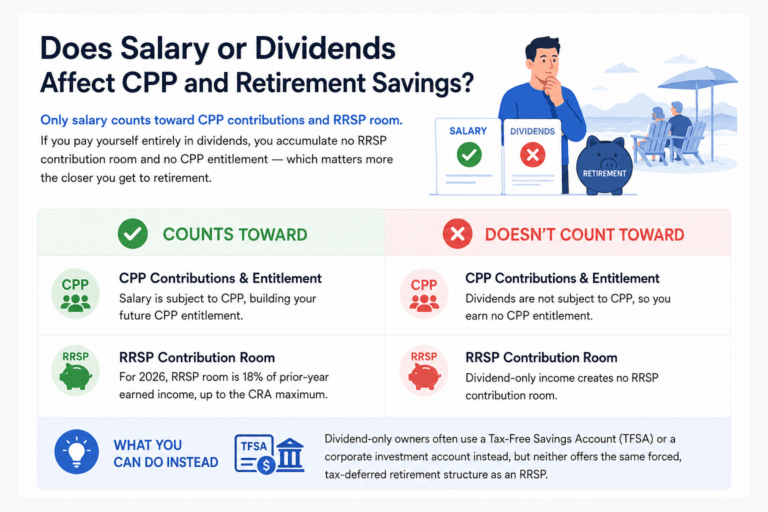
Only salary counts toward CPP contributions and RRSP room. If you pay yourself entirely in dividends, you accumulate no RRSP contribution room and no CPP entitlement – which matters more the closer you get to retirement.
For 2026, RRSP contribution room is calculated as 18% of prior-year earned income, up to the annual CRA maximum. Dividend-only owners often compensate with a Tax-Free Savings Account (TFSA) or a corporate investment account instead, but neither offers the same forced, tax-deferred retirement structure as an RRSP.
What About Administrative Cost and Complexity?
Salary requires you to register a CRA payroll account, issue T4 slips annually, and remit source deductions monthly or quarterly depending on your remittance schedule. Missing a remittance deadline triggers penalties, so most owners paying salary use a bookkeeper or payroll service.
Dividends require a T5 slip and are generally simpler to administer, but they still need to be properly documented through corporate resolutions and recorded in the shareholder’s dividend account. Skipping this paperwork is a common audit flag.
A Practical Example: The Mixed Approach
Many Ontario business owners land on a hybrid: a modest salary – often set to match RRSP maximization thresholds – topped up with dividends for the remainder of their draw. This approach captures RRSP room and CPP credits from the salary portion while keeping payroll administration lighter than a full-salary structure.
There’s no universal “right” split. An accountant modelling your specific numbers against current CRA rates will give you a more precise answer than any general rule of thumb.
🏢 How Do You Incorporate in Ontario Before Making This Decision?
Before deciding whether to pay yourself through salary, dividends, or a combination of both, you'll first need to legally incorporate your business. Here's what the Ontario incorporation process typically involves.
📄 Required Documents
The legal document that creates your corporation, including its name, share structure, directors, and registered office.
Required only for named corporations. The report confirms your business name is available and remains valid for 90 days.
Must be filed within 60 days after incorporation and includes your directors and registered office information.
Contains bylaws, share certificates, and corporate resolutions. Although it's not filed with the government, it's an important legal record every corporation should maintain.
🚀 Registration Steps
- Choose a Corporation Name
Select either a numbered corporation or a named corporation requiring a NUANS report. - Choose Federal or Ontario Incorporation
Ontario incorporation is generally the simpler and more cost-effective choice if your business operates only within Ontario. - File Articles of Incorporation
Submit your application through the Ontario Business Registry. - Pay the Government Filing Fee
Complete payment to finalize your incorporation application. - Receive Your Certificate of Incorporation
This confirms your corporation has been legally created. - File Your Initial Return
Submit Form 1 within 60 days to keep your corporation compliant.
💼 Need Help Incorporating?
If you'd rather avoid preparing legal documents, completing government filings, and tracking post-incorporation requirements, Biz Ontario can manage the entire incorporation process for you - from preparing your Articles of Incorporation to setting up your corporate records.
💰 How Much Does Ontario Incorporation Cost?
The total cost of incorporating in Ontario depends on whether you file the application yourself or use a professional service. Here's a typical cost breakdown.
Government Filing
Standard online filing fee through the Ontario Business Registry.
NUANS Report
Required only for named corporations. Numbered corporations do not require a NUANS search.
Professional Help
Optional cost if you hire a lawyer or paralegal to prepare your incorporation documents and minute book.
Incorporate with Confidence
If you'd rather avoid navigating the Ontario Business Registry, ordering NUANS reports, preparing incorporation documents, or tracking Initial Return deadlines, Biz Ontario can manage the entire process on your behalf.
What Is an Ontario Certificate of Incorporation?
The Certificate of Incorporation is the government-issued proof that your corporation legally exists as of a specific date. Banks require it to open a corporate account, and it’s the document that formally starts the clock on your 60-day Initial Return deadline. It’s issued automatically upon approval when filing through the Ontario Business Registry.
⚖️ Myth vs. Fact: Salary, Dividends & Incorporation
There's a lot of outdated and misleading advice online about paying yourself through a corporation. Here's what Ontario business owners should know before making a decision.
| ❌ Myth | ✅ Fact |
|---|---|
| Dividends are always more tax-efficient than salary. | Not necessarily. The better option depends on your income, province, and long-term goals. Salary also creates RRSP contribution room and CPP benefits, which can provide significant long-term value. |
| You don't need payroll registration if you're the only employee. | If you pay yourself a salary, you still need a CRA payroll account and must issue yourself a T4, even if you're the corporation's only employee. |
| Federal incorporation is always better. | Federal incorporation provides broader name protection, but businesses operating only in Ontario often find provincial incorporation simpler and more cost-effective. |
| Paying only dividends is always the smartest strategy. | Dividend-only compensation reduces administration but also means no CPP contributions and no RRSP contribution room, which may affect long-term retirement planning. |
| Personal assets are automatically protected after incorporation. | Incorporation provides limited liability, but that protection can be lost if corporate formalities—such as maintaining a proper minute book and keeping personal and business finances separate—are ignored. |
💡 Bottom Line
There is no universal "best" way to pay yourself from a corporation. The right approach depends on your income, future business plans, retirement goals, and tax situation. Choosing between salary, dividends, or a combination of both should be based on your specific circumstances - not common myths or one-size-fits-all advice.
Frequently Asked Questions
Can I pay myself both salary and dividends in the same year?
Yes. There's no rule against combining both. Many Ontario corporation owners use a mixed structure specifically to balance RRSP and CPP benefits against administrative simplicity.
Do I need a payroll account if I only pay dividends?
No. If you pay yourself exclusively in dividends, you don't need to register a CRA payroll account, since dividends aren't subject to source withholding.
How long does Ontario incorporation take?
Online filings through the Ontario Business Registry are typically processed within minutes to a few business days, assuming your NUANS report (if applicable) and documents are in order.
Is dividend income taxed differently than salary income personally?
Yes. Dividends are subject to a gross-up and dividend tax credit mechanism to account for corporate tax already paid, resulting in a different effective personal tax rate than employment income.
Should I incorporate federally or provincially in Ontario?
If you only plan to operate in Ontario, provincial incorporation is usually cheaper and simpler. Federal incorporation makes more sense if you plan to operate or hold name protection across multiple provinces.