


Registered charities in Ontario must file an annual T3010 return within six months of their fiscal year-end, meet an annual disbursement quota, issue tax receipts correctly, and keep their activities within the limits of their charitable purposes. Miss any of these, and the Canada Revenue Agency (CRA) can revoke charitable status – a consequence that costs an organization its tax-receipting privileges and, in some cases, triggers a revocation tax equal to nearly all its remaining assets. This article walks through each requirement in plain terms, starting with how charity registration in Ontario sets the foundation for compliance.
How Does Charity Registration in Ontario Connect to CRA Compliance?
Before an organization can face CRA compliance obligations, it has to become a registered charity – and that process starts provincially. If you want to register a charity in Ontario, you first incorporate as a not-for-profit under Ontario’s Not-for-Profit Corporations Act (ONCA) or federally under the Canada Not-for-profit Corporations Act, then apply to the CRA for charitable registration using Form T2050.
This distinction trips up a lot of founders. Incorporating a non-profit in Ontario does not automatically make you a registered charity – it just gives you legal existence as a corporation. Charitable status, with the ability to issue official donation receipts, is a separate federal designation granted only by the CRA’s Charities Directorate.
I’ve worked with several Ontario founders who registered a non-profit organization in Ontario expecting instant charitable status, then were surprised the CRA review took 6 to 12 months and required a detailed statement of activities, not just a mission statement.
Non-Profit vs. Registered Charity: What’s the Actual Difference?
This is the single most common point of confusion when people search for how to register a non-profit business in Ontario. The two are not interchangeable, and CRA compliance rules only apply to one of them.
| Feature | Non-Profit Organization (NPO) | Registered Charity |
|---|---|---|
| Can issue tax receipts | No | Yes |
| Governing registration | Provincial (ONCA) or federal (CNCA) incorporation | CRA charitable registration (Form T2050) |
| Annual CRA filing | T1044 (if applicable) | T3010, mandatory |
| Disbursement quota | Not applicable | Applies (generally 3.5%–5%) |
| Purpose restrictions | Broad, non-profit purposes allowed | Must fit CRA's four recognized charitable categories |
| Public disclosure | Limited | Financials and activities public via CRA |
If your goal is community or member benefit without receipting donations, registering a non-profit in Ontario alone may be sufficient. If you need to issue donation receipts to attract funders, you need CRA charitable registration on top of incorporation.
What Are the Core CRA Compliance Requirements for Registered Charities?
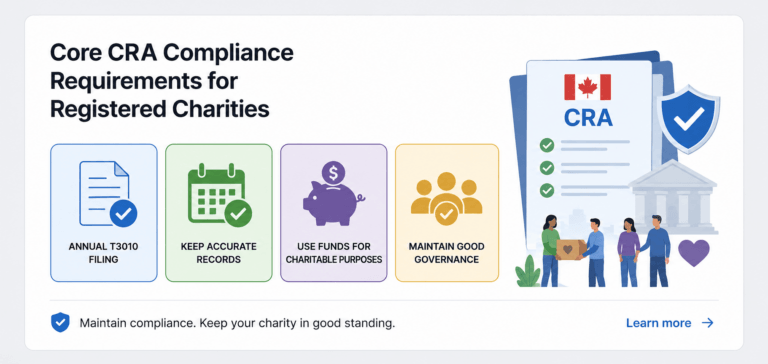
Once registered, a charity takes on ongoing legal obligations to the CRA. These are the ones that matter most in practice.
📋 Ongoing Compliance Requirements for Ontario Charities
1️⃣ File the T3010 Annual Information Return
Every registered charity must file Form T3010 within 6 months after its fiscal year-end. Filing late can result in the loss of registered charitable status. Filing through CRA My Business Account (MyBA) helps ensure you're using the correct version of the form.
2️⃣ Meet the Disbursement Quota
Registered charities must spend a minimum amount each year on charitable activities or qualified disbursements. The applicable quota depends on the value of the charity's assets and current CRA rules.
3️⃣ Issue Donation Receipts Correctly
Official donation receipts must contain all information required by the Income Tax Act, including your charity registration number, donor details, receipt number, and donation amount.
4️⃣ Stay Within Your Charitable Purposes
Your activities must remain consistent with your organization's approved charitable purposes. Operating outside those purposes or engaging in non-compliant activities may trigger a CRA review.
5️⃣ Maintain Books & Records
Keep financial records, governing documents, meeting minutes, receipts, and supporting documentation for at least 6 years. These records must be available if requested by the CRA.
What Happens If a Charity Falls Out of Compliance?
Non-compliance carries real consequences, on a graduated scale:
- Education letter – CRA flags a minor issue and requests correction.
- Compliance agreement – a formal commitment to fix specific problems by a deadline.
- Sanctions – including suspension of receipting privileges for a period.
- Revocation – the charity loses registered status entirely.
- Revocation tax – a tax roughly equal to the charity’s remaining net assets, payable within one year of revocation, unless assets are transferred to another registered charity.
Losing charitable status doesn’t just end a filing obligation – it typically ends an organization’s ability to fundraise from donors expecting a tax receipt, which for most charities is close to an existential threat.
Practical Insight: Where Ontario Charities Actually Go Wrong
In my experience advising Ontario-based organizations through this process, the single biggest compliance failure isn’t fraud or bad intent – it’s timeline mismatch. Founders register a non-profit in Ontario, apply for charitable status, get approved, and then treat the T3010 like an afterthought because their first fiscal year felt “too small to matter.” The CRA disagrees: the six-month filing deadline applies from year one, regardless of revenue size, and a first-year late filing is exactly the kind of pattern that puts a young charity on CRA’s radar for a full review.
The second-most common issue is disbursement quota miscalculation, particularly among newer charities holding donated investment assets. Many don’t realize the 5% rate above the $1 million threshold applies to the average value of property not used directly in charitable work – not just idle cash sitting in a bank account.
Frequently Asked Questions
How long does it take to register a charity in Ontario?
Provincial incorporation as a non-profit typically takes days to a few weeks. CRA charitable registration, filed separately using Form T2050, generally takes 6 to 12 months depending on the complexity of the application.
Do I need to register a non-profit in Ontario before applying for charitable status?
Yes, in most cases. You first incorporate as a not-for-profit corporation, either provincially under ONCA or federally under the CNCA, then apply to the CRA's Charities Directorate for charitable registration.
Can a non-profit organization issue tax receipts without CRA charitable registration?
No. Only organizations with CRA-approved registered charity status can issue official donation tax receipts. A non-profit that hasn't completed charitable registration cannot legally issue them.
What is the penalty for filing the T3010 late?
Late or missing T3010 filings put a charity at risk of losing its registered status. The CRA typically sends a reminder or notice of intent to revoke before formal revocation, but repeated late filing significantly increases compliance and audit risk.
Does registering a non-profit business in Ontario require a lawyer?
It's not legally required, but given how ONCA governance rules and CRA charitable purpose requirements interact, many founders use a lawyer or incorporation service for the ONCA filing and a charity-law specialist for the CRA application to avoid delays.