


Entrepreneurs are turning to the Ontario co-operative model because it lets multiple founders, workers, or customers share ownership and voting power equally, while still operating as a fully incorporated business under provincial law. In Ontario, this means incorporating under the Co-operative Corporations Act (CCA) rather than the standard Business Corporations Act. The result is a structure built for shared control and long-term stability, not quick equity exits.
This shift isn’t nostalgia for a 19th-century idea. It’s a practical response to succession problems, financing gaps, and a workforce that increasingly wants a stake in what it builds.
What Is a Co-operative, Exactly?
An Ontario co-operative (co-op) is a business owned and democratically controlled by its members, where each member typically gets one vote regardless of how much capital they’ve contributed. Ontario co-ops are governed by the Co-operative Corporations Act, R.S.O. 1990, c. C.35, administered jointly by the Ministry of Public and Business Service Delivery and Procurement and the Financial Services Regulatory Authority of Ontario (FSRA) for financing-related matters.
Here’s a quick reference for how the model differs from other structures:
| Feature | Co-operative | Standard Corporation | Sole Proprietorship |
|---|---|---|---|
| Ownership | Members, one member = one vote | Shareholders, votes tied to shares | Single owner |
| Governing legislation (Ontario) | Co-operative Corporations Act | Business Corporations Act (OBCA) | No incorporation statute |
| Profit distribution | Patronage returns based on use | Dividends based on shares held | Owner keeps all profit |
| Decision-making | Democratic, one vote per member | Proportional to shareholding | Owner decides alone |
| Minimum members to incorporate | 3 (with some exceptions) | 1 | N/A |
Why Are Entrepreneurs Rediscovering This Model Now?
Three forces are converging: aging business owners without successors, gig and platform workers wanting equity, and consumers who want more say in the businesses they depend on.
Succession is the biggest driver. Many small Ontario businesses face retiring owners with no buyer lined up. Converting to a worker co-op lets employees purchase the business gradually through patronage capital rather than needing a lump-sum loan.
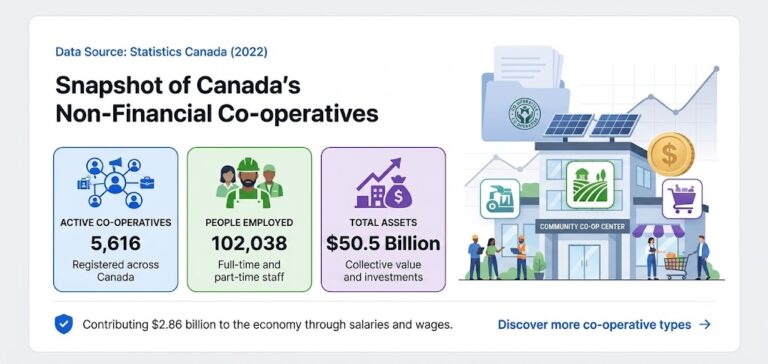
Worker co-ops are also proving resilient. Statistics Canada’s most recent data on non-financial co-operatives shows there were 5,616 active non-financial co-operatives in Canada in 2022, holding $50.5 billion in total assets and employing 102,038 people while paying $2.86 billion in salaries and wages. That’s not a fringe sector – it’s a durable part of the economy that has held steady through multiple downturns.
Ontario specifically carries real weight in this picture. Ontario has historically held the second-largest share of Canada’s active co-operatives, behind only Quebec, which means the provincial ecosystem of lenders, accountants, and legal advisors who understand co-ops is more mature here than in most provinces.
What Does the Ontario Co-operative Corporations Act Actually Require?
The CCA sets out the rules for how a co-op must be structured, governed, and financed. It’s more prescriptive than the OBCA in some areas – particularly around member voting and capital raising – because it’s designed to protect the democratic character of the business, not just its shareholders.
Key requirements under the Act include:
- Minimum of three incorporators in most cases (with some allowances for specific co-op types).
- One member, one vote, regardless of shares or patronage held – this can’t be contracted around.
- A stated co-operative purpose in the articles, describing how the business will serve its members.
- Restrictions on share transferability – co-op shares generally can’t be freely traded like corporate shares.
- Offering statement requirements if the co-op wants to raise capital from members or the public, reviewed by FSRA to ensure “full, true and plain disclosure” under the Act.
If your Ontario co-op plans to raise money through member shares beyond a small, closely held group, expect FSRA’s offering statement review to be part of your timeline – this is a step many first-time incorporators miss and it can add weeks if you haven’t drafted for it in advance.
🤝 How Do You Register a Co-operative in Ontario? (Step-by-Step)
- Choose Your Co-op Structure – Select the type of co-operative and determine whether it will operate with or without share capital.
- Reserve Your Name – Complete a NUANS Name Search to confirm your proposed name is available before filing.
- Prepare Your Articles of Incorporation – Draft the required Articles under the Co-operative Corporations Act (CCA), including your co-op's purpose, share structure, directors, and incorporators.
- Draft Your By-laws – Create internal governance rules covering member meetings, board elections, voting procedures, and patronage returns.
- Submit Your Application – File your incorporation documents through the Ontario Business Registry or by paper submission to the Ministry of Public and Business Service Delivery and Procurement, together with the required government filing fee.
- Wait for Ministry Approval – Unlike standard corporations, Ontario co-operatives require a ministry review before incorporation is approved.
- Register with the CRA – Apply for a Business Number (BN) and register for any required tax accounts. Co-operatives must file an annual T2 Corporate Income Tax Return.
- Prepare an Offering Statement (If Required) – If your co-op plans to raise capital by selling shares or memberships beyond an exempt group, you'll also need to prepare an offering statement for FSRA.
✔ Let Biz Ontario Handle the Process
If navigating Ontario's Co-operative Corporations Act, incorporation forms, and governance requirements feels overwhelming, Biz Ontario can simplify the entire process from start to finish.
What Does It Cost to Register an Ontario Co-operative?
Costs vary depending on whether you use a lawyer or file yourself, but plan for three categories of expense: the government filing fee, the NUANS name search fee, and professional drafting costs for your articles and by-laws (which tend to run higher than a standard corporation because co-op by-laws must address patronage, voting, and member classes in more detail). Confirm current government filing fees directly with the Ontario Business Registry, as fee schedules are updated periodically.
What’s an Original Insight Most Guides Miss?
The part entrepreneurs underestimate isn’t the filing – it’s the by-law drafting. A standard corporation’s shareholder agreement can borrow heavily from templates. A co-op’s by-laws have to define patronage allocation formulas, membership classes, and voting mechanics in ways that actually match how the business operates day to day.
In practice, co-ops that skip a real governance conversation at the drafting stage – and just copy a template – tend to hit conflict within the first two years, usually over how patronage is calculated or who qualifies for membership. Building that clarity in up front, even though it slows the incorporation timeline by a few weeks, is cheaper than renegotiating by-laws with an active, divided membership later.
🏛 ️Who Regulates Co-operatives in Ontario?
Ontario co-operatives are overseen by two different government bodies. Knowing which organization handles which responsibility can save you time and help ensure your filings go to the right place.
📄 Ministry of Public and Business Service Delivery and Procurement
- Co-operative incorporation
- Articles of Incorporation
- Annual returns
- Corporate filings and records
- General administration under the Co-operative Corporations Act
🛡️Financial Services Regulatory Authority of Ontario (FSRA)
- Reviews offering statements
- Oversees co-ops raising investment capital
- Focuses on investor protection
- Does not manage routine corporate filings
Frequently Asked Questions
Is an Ontario co-operative the same as a non-profit?
No. An Ontario co-operative can be for-profit or not-for-profit, but its defining feature is member ownership and democratic control, not tax status. Many Ontario co-ops are incorporated for-profit and distribute patronage returns to members based on use of the co-op's services.
Can one person start a co-operative in Ontario?
Generally no. The CCA requires a minimum number of incorporators, typically three, reflecting the co-op's collective ownership model. If you're a solo founder, a standard corporation or sole proprietorship is usually the faster path.
How is a co-operative taxed compared to a regular corporation?
Co-operatives file a T2 corporate income tax return with the CRA just like other corporations, and patronage returns paid to members can often be deducted, similar to how dividends work differently for standard corporations. Speak with an accountant familiar with co-op patronage rules before finalizing your structure.
Do co-operative shares trade like stock?
No. Co-op shares are generally restricted from free transfer and don't fluctuate in value the way corporate shares do on an exchange. They're tied to membership and patronage rather than speculative value.
What industries use the co-op model most in Ontario?
Historically, real estate and rental/leasing, wholesale and retail trade, and agriculture have made up a large share of active non-financial co-operatives nationally. Worker co-ops are also growing in professional services and the platform economy as succession planning drives more conversions.