


A general partnership in Ontario with family members can work well for a small, low-risk operation where everyone trusts each other, and the business won’t take on significant debt – but it’s a poor fit once real money, liability, or unequal effort enters the picture. Under Ontario’s Partnerships Act, every partner is personally on the hook for the debts and actions of the others, including family members, so the real question isn’t “can we get along” but “can we survive what happens if we don’t, or if the business fails.” Most family partnerships that go wrong do so not because of malice, but because nobody put the hard conversations in writing before the business needed them.
This article covers what a family general partnership in Ontario actually exposes you to, how Ontario registration works step by step, and what to put in a partnership agreement so family relationships survive the business – even if the business doesn’t survive.
What Is a General Partnership Under Ontario Law?
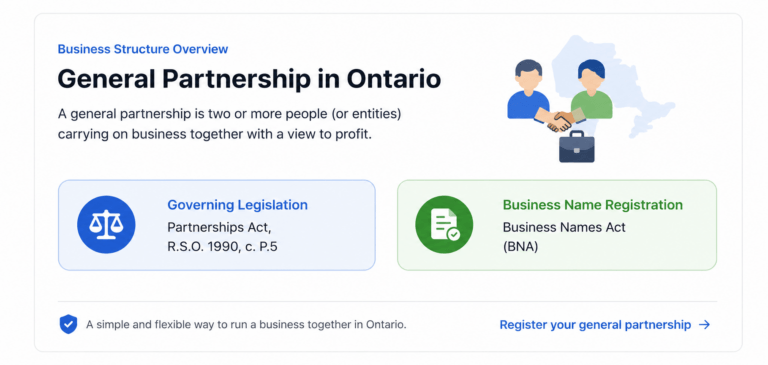
A general partnership in Ontario is two or more people (or entities) carrying on business together with a view to profit. In Ontario, this structure is governed by the Partnerships Act, R.S.O. 1990, c. P.5, and the naming of the business falls under the Business Names Act (BNA). There’s no incorporation involved — the partnership isn’t a separate legal person, which is the single most important fact for family members to understand before signing anything.
⚖️ Key Legal Characteristics of a General Partnership
Understanding these legal characteristics is essential before registering a general partnership in Ontario.
-
🏢 No Separate Legal Entity
The partnership is a legal relationship between the partners - not a separate corporation or company. -
⚠️ Unlimited Personal Liability
Each partner is personally responsible for the partnership's debts, including obligations created by another partner. -
🤝 Joint and Several Liability
A creditor can pursue any one partner for the entire debt, not just their proportional share. Partners must later settle reimbursements privately. -
✍️ Agency Authority
Under Ontario law, each partner can legally bind the partnership through contracts made during the ordinary course of business, even without unanimous approval. -
💰 Equal Profit Sharing by Default
Unless a written partnership agreement states otherwise, Ontario law assumes partners share profits and losses equally, regardless of how much money or work each person contributes.
💡 Practical Example
This rule often surprises family businesses. For example, if one sibling invests $80,000 while another contributes only $5,000, Ontario law still assumes a 50/50 split of profits and losses unless a written partnership agreement specifies a different arrangement.
Why Family Partnerships Are Different from Partnerships Between Strangers
Family ties change the emotional and financial stakes of a partnership in ways that are easy to underestimate at the start.
The advantages are real. Family partners typically bring higher trust, faster decision-making, and a shared long-term stake in the business’s reputation – nobody wants to embarrass the family name. Startup costs are usually lower, too, since family members are more likely to defer formal pay or lend money informally in the early months.
The risks are also amplified, not reduced. A dispute with a business partner who’s also your brother, mother, or spouse doesn’t stay contained to the business – it follows you to Thanksgiving. And because the Partnerships Act imposes unlimited joint liability, a bad decision by one family member (missed tax remittance, a lawsuit from a customer, a personal-guarantee default) can put every other partner’s house, savings, and credit at risk, family loyalty notwithstanding.
[Tetiana Diordytsia, marketing specialist at Biz Ontario, puts it this way from working with dozens of first-time family filers: “The families who do well are the ones who write down who owns what and who decides what before the business has any money. The families who struggle are the ones who assumed the relationship would sort it out, because a handshake doesn’t hold up when a supplier is suing for $40,000, and the person named on the contract is your uncle.”
General Partnership vs. Other Structures: Which Fits a Family Business?
| Structure | Legal entity? | Liability | Ontario registration fee | Best fit for a family business |
|---|---|---|---|---|
| Sole proprietorship | No | Unlimited, personal | $60 | One family member owns it; others are employees, not partners |
| General partnership | No | Unlimited, joint and several | $60 | Low-risk business, high trust, modest revenue |
| Limited partnership (LP) | No (but has limited partners) | General partner(s): unlimited; limited partner(s): capped to investment | $210 | A parent invests capital but a sibling runs day-to-day operations |
| Ontario corporation | Yes | Limited to corporate assets (generally) | $300 (provincial) | Business carries real liability risk, growth plans, or outside financing |
| Limited Liability Partnership (LLP) | No | Limited for licensed professionals only (e.g., accountants, lawyers) | $60 | Restricted to regulated professions — not available to most family businesses |
If the business will hold significant debt, sign leases, hire staff, or face any real liability exposure (a restaurant, a contracting business, anything customer-facing with injury risk), a corporation is usually the safer long-term structure even though it costs more upfront and adds ongoing filing obligations under the Ontario Business Corporations Act.
📋 How Do You Register a General Partnership in Ontario?
Registering a general partnership in Ontario is a business name registration, not an incorporation. Follow these simple steps:
-
Choose & Search Your Business Name
Search the Ontario Business Registry to check whether your proposed business name is available. While a NUANS report isn't required, it's still a good idea to avoid choosing a name that's already in use. -
Gather Your Business Information
Prepare the legal names and residential addresses of all partners, your business address, principal business activity (NAICS code), and contact information. -
Register Through the Ontario Business Registry
The government filing fee is currently $60 for a General Partnership.
If you find the registration process confusing or time-consuming, Biz Ontario can complete the entire registration on your behalf through one convenient package.
We assist with:
- Ontario & Federal Incorporations
- Sole Proprietorships
- Trade Name Registrations
- General Partnerships
- Professional Corporations
- Company Key Retrieval
- Annual Return Filings
- CRA Program Account Registrations
- Business Compliance Services
More than 5,000 businesses have successfully registered through Biz Ontario, and new registrations are added every day.
-
Receive Your Business Identification Number (BIN)
Once approved, you'll receive your Ontario Business Identification Number (BIN), confirming your registration is active. -
Register for CRA Accounts
Apply for a CRA Business Number (BN) if you'll need GST/HST, payroll, import/export, or corporate tax accounts. -
Create a Written Partnership Agreement
Although not legally required, a written agreement is highly recommended to define ownership, responsibilities, profit sharing, and dispute resolution. -
Open a Business Bank Account
Open a dedicated bank account in your partnership's registered business name to separate personal and business finances. -
Renew Every 5 Years
General Partnership registrations expire every five years. Be sure to renew before the expiry date to keep your business name active.
💡 Pro Tip
Many partnerships fail because they never create a written partnership agreement. Even among family members or close friends, having clear terms for ownership, profit sharing, decision-making, and dispute resolution can prevent costly disagreements later.
What Should Be in an Ontario General Partnership Agreement?
Ontario law does not require a written partnership agreement – a partnership can legally exist on a verbal understanding. For a family business, that’s exactly the gap that causes the most damage later. A written agreement overrides the Partnerships Act defaults (like the automatic 50/50 profit split) with terms the family actually agreed to.
A solid family partnership agreement should address:
- Capital contributions: who put in what, in cash, assets, or unpaid labour, and how that’s valued.
- Profit and loss allocation: the actual percentage split, which does not need to match ownership or capital contribution if the family agrees otherwise.
- Decision-making authority: which decisions need unanimous consent (taking on debt, hiring family vs. non-family, selling the business) versus which a single partner can make alone.
- Roles and compensation: whether partners draw a salary in addition to profit share, and what happens if one partner’s involvement drops (a parent semi-retiring, for example).
- Dispute resolution: a required mediation step before anyone goes to court, which matters enormously when litigation would otherwise mean suing a relative.
- Exit and buyout terms: how a partner leaves, retires, becomes disabled, divorces, or dies, and how their share is valued and paid out (this is the clause families skip most often, and regret skipping most).
- Death or incapacity of a partner: without a clause addressing this, a deceased partner’s estate – which may include an in-law who was never involved in the business – can become a partner by default.
A lawyer drafting this agreement typically costs less than the legal fees for one contested dispute later. This is the practical trade-off worth stating plainly to family members who see the agreement as a sign of distrust: it isn’t insurance against family conflict, it’s the thing that lets the business survive the conflict when it happens.
What Are the Tax Obligations for a Family Partnership?
A partnership itself doesn’t pay income tax in Canada – income and losses flow through to each partner, who reports their share on their own T1 (individuals) or T2 (corporate partners) return using Form T2125. Most small family partnerships stop there.
However, the CRA requires a T5013 Partnership Information Return if the partnership meets certain thresholds: combined revenue and expenses exceeding $2 million, assets exceeding $5 million, or if any partner is a corporation or trust rather than an individual. Family partnerships that stay small and keep every partner as an individual usually fall under this threshold and aren’t required to file, though filing voluntarily can still be useful for tracking each partner’s allocated share cleanly.
GST/HST registration becomes mandatory once the partnership’s total taxable revenue exceeds $30,000 over four consecutive calendar quarters, at which point the partnership (not each partner) registers for a single GST/HST account under its Business Number.
Frequently Asked Questions
Do I need a lawyer to register a general partnership in Ontario?
No. Registration itself is a straightforward online filing through the Ontario Business Registry. A lawyer isn't required for the registration step, but is strongly recommended for drafting the partnership agreement, which helps protect family relationships, define responsibilities, and clarify how business decisions and liabilities are handled.
Can one family member register the partnership on behalf of everyone?
Yes. Whoever files the registration must include the full legal names and addresses of all partners, but the registration itself can be submitted by one designated person. This doesn't change anyone's legal liability — every named partner is still personally liable regardless of who submits the registration.
What happens if my sibling or parent racks up business debt without telling me?
Under the joint and several liability rule in the Partnerships Act, creditors can pursue you personally for the full amount, leaving you to seek reimbursement from your family co-partner separately. This is precisely the type of situation a written partnership agreement with clear spending-authority limits can help prevent.
Can we convert the partnership into a corporation later if the business grows?
Yes. Many family businesses start as a general partnership to keep costs low, then incorporate once revenue, liability exposure, or a need for outside financing justifies the higher setup cost and ongoing compliance requirements under the Ontario Business Corporations Act.
Do all partners need to actively work in the business?
No. A partner can contribute capital without working in the business day-to-day, but they still carry full unlimited liability as a general partner. If a family member wants to invest without the same liability exposure, a limited partnership, with that person as a limited partner, may be a more appropriate structure than a general partnership.