


To start an Ontario not-for-profit organization, you incorporate under the Ontario Not-for-Profit Corporations Act (ONCA) by filing Articles of Incorporation through Biz Ontario, paying a $499 filing fee, and naming at least three directors. Incorporation gives you legal status right away; if you also want to issue tax receipts, you then apply separately to the Canada Revenue Agency (CRA) for registered charity status. The whole incorporation step typically takes a few business days once your paperwork is in order.
That’s the short version. Below is the full process, including the parts that trip up first-time founders – name approval, the Initial Return deadline, and the difference between “not-for-profit” and “charity,” which are two different legal statuses that people constantly mix up.
What Is the Ontario Not-for-Profit Corporations Act (ONCA)?
ONCA is the piece of provincial legislation that governs how nonprofits incorporated in Ontario are formed and run. It was proclaimed on October 19, 2021, replacing the older Corporations Act and modernizing rules around electronic voting, virtual meetings, and online filing.
The Act sets out requirements for articles of incorporation, director duties, bylaws, membership classes, and annual filings. It applies to most Ontario nonprofit incorporation services – community groups, sports clubs, arts organizations, and registered charities that chose provincial rather than federal incorporation. If you’re weighing provincial versus federal registration, the practical dividing line is geography: ONCA suits organizations that operate mainly inside Ontario, while the federal Canada Not-for-Profit Corporations Act (CNCA) suits those planning to operate across provinces.
One detail people often get wrong: bylaws don’t get filed with the government. They’re your internal rulebook, but they still have to comply with ONCA’s requirements around meetings, voting, and membership rights.
🏛 How Do You Register a Not-for-Profit Organization in Ontario?
Here's the sequence most incorporators follow when registering a non-profit corporation in Ontario.
-
Choose Your Corporate Name
Select a name that isn't deceptively similar to an existing corporation or trademark. Words like "Limited" or "Ltd." are usually omitted for non-profit organizations. -
Run a NUANS Name Search
A Newly Upgraded Name Search Report generally costs $22–$40 and is valid for 90 days. If you prefer, you can incorporate as a numbered corporation instead. -
Recruit at Least Three Directors
Ontario's ONCA requires a minimum of three directors, each at least 18 years old and legally qualified to serve. -
Prepare Your Articles of Incorporation
Your articles must include your organization's non-commercial purpose, Ontario registered office address, and incorporator information. -
File Your Application
The current Ontario government filing fee is approximately $499.
Many organizations choose Biz Ontario to simplify the incorporation process. We prepare and submit all required documents while ensuring your application meets current Ontario filing requirements.
More than 5,000 businesses and organizations have successfully registered through Biz Ontario.
-
Receive Your Certificate of Incorporation
This certificate confirms your organization has been legally incorporated and is required for banking, funding applications, and CRA registrations. -
File Your Initial Return
Submit your Initial Return within 60 days after incorporation to confirm your organization's officers and registered office. -
Adopt By-laws & Hold Your First Meetings
Adopt organizational by-laws and hold the first directors' and members' meetings within the required timeframe. -
Create Your Minute Book
Maintain your corporation's minute book along with registers for directors, officers, and members. -
Register for CRA Accounts
Apply for a CRA Business Number (BN) and, if applicable, register for GST/HST or apply for charitable status with the Canada Revenue Agency.
💡 Helpful Tip
Before submitting your application, verify that your organization's purpose clause accurately reflects its intended activities. Making corrections after incorporation often requires additional filings, fees, and processing time.
Ontario Incorporation vs. Federal Incorporation: Which Should You Choose?
This is the comparison most founders need before they file anything.
| Factor | Ontario (ONCA) | Federal (CNCA) |
|---|---|---|
| Government filing fee | $155 | $200 |
| Director residency | No Canadian residency requirement | At least 25% must be Canadian citizens/permanent residents |
| Best suited for | Organizations operating mainly within Ontario | Organizations operating in multiple provinces |
| Name protection | Protected in Ontario only | Protected Canada-wide |
| Extra-provincial registration needed? | Yes, if you expand outside Ontario | Not usually needed to operate in other provinces |
| Ongoing compliance | Ontario Business Registry annual returns | Corporations Canada annual returns |
If you’re fairly confident your work stays inside Ontario – a local arts collective, a neighbourhood sports league, a regional advocacy group – provincial incorporation is simpler and cheaper. If you’re already planning chapters in other provinces, federal incorporation saves you from filing extra-provincial registrations later.
Not-for-Profit vs. Registered Charity: What’s the Difference?
This is the single most common point of confusion, so it’s worth spelling out clearly.
- Not-for-profit corporation: A legal entity created through ONCA (or CNCA) incorporation. It can operate, hold assets, and enter contracts, but it cannot issue official donation receipts.
- Registered charity: A separate tax status granted by the CRA Charities Directorate, on top of incorporation. Only registered charities can issue receipts for income tax purposes and are generally exempt from income tax under stricter rules.
You must incorporate first, then apply to the CRA – there’s no way to skip incorporation and go straight to charitable status, with very rare exceptions for certain government entities. CRA review of a charitable application commonly takes six to twelve months, so if tax receipts are core to your fundraising plan, build that timeline into your launch.
What Records Do You Need to Keep Under ONCA?
Every Ontario not-for-profit has to maintain a minute book, which acts as the organization’s permanent legal record. At minimum, it should contain:
- Articles of Incorporation and any amendments
- Bylaws, current and historical versions
- Minutes from all board, member, and committee meetings
- Director register: names, service addresses, start dates, plus records for anyone who served in the past six years
- Officer register: same format as the director register
- Member register: names, membership class (if applicable), start dates, and records for departed members going back six years
A practical habit I recommend to founders: set a recurring quarterly reminder to update these registers rather than scrambling before an annual return is due. Missed registers are one of the more common reasons boards get caught off guard during a grant funder’s due diligence review.
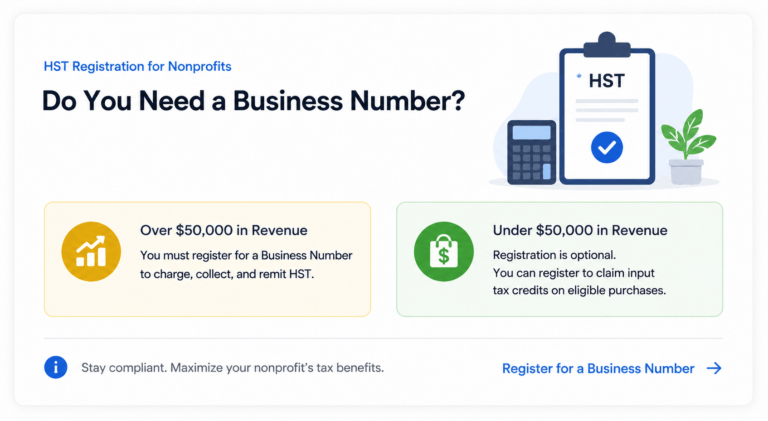
Do You Need to Register for HST?
If your organization’s revenue from taxable activities exceeds $50,000 within any 12-month period, you’re required to register for a Business Number to charge, collect, and remit HST. Below that threshold, registration is optional – some smaller nonprofits register voluntarily anyway so they can claim input tax credits on eligible purchases.
Common Mistakes That Delay Ontario Not-for-Profit Registration
According to incorporation practitioners, most rejected or delayed applications trace back to a handful of avoidable issues:
- Incomplete or vague purpose statements in the Articles – the CRA and the registry both want a clearly stated, non-commercial mission.
- Name conflicts caught late because the NUANS search wasn’t refreshed before filing (reports expire after roughly 90 days).
- Missing the Initial Return deadline, which risks administrative cancellation.
- Treating the organization’s bank account like a personal one – always keep nonprofit funds in a dedicated account.
- Assuming incorporation equals charitable status – they are two separate applications with two separate timelines.
Why File Through an Experienced Agency Instead of DIY?
Nothing above is technically hard to file yourself - but the process rewards experience, and that's exactly where an agency earns its fee back. An experienced filer catches the naming conflicts, incomplete purpose clauses, and missing Initial Return deadlines before they become rejections or administrative dissolutions, rather than after.
At Biz Ontario, we've incorporated more than 5,000 businesses and nonprofits, so we've already seen the edge cases.
That track record is the difference between a filing that goes through in a few business days and one that bounces back for corrections weeks later.
Frequently Asked Questions
How much does it cost to start a not-for-profit in Ontario?
Expect roughly $155 for the government filing fee, plus $22–$40 for a NUANS name search if you want a distinctive name rather than a numbered corporation. Legal or filing-service fees are additional if you use a lawyer or incorporation service.
How many directors does an Ontario not-for-profit need?
ONCA requires a minimum of three directors. Unlike for-profit corporations, a nonprofit cannot be run by a sole director. The Act is built around shared board governance.
Can a not-for-profit make money in Ontario?
Yes, but any surplus has to be reinvested into the organization's stated purpose rather than distributed to members or directors. Commercial activity is allowed as long as it supports the nonprofit's mission rather than becoming an end in itself.
Do Ontario not-for-profits pay income tax?
Generally no. Nonprofits are usually exempt from income tax, though some must still file a T1044 Non-Profit Organization Information Return with the CRA depending on their revenue and assets.
How long does it take to incorporate a not-for-profit in Ontario?
Electronic filing through the Ontario Business Registry is often processed within a few business days. The slower part is usually the CRA charitable status application afterward, which can take six to twelve months if you're pursuing charitable registration separately.