


Registering your business with a provincial or federal government gives you almost no protection against someone else using your name. The only way to legally lock down a business name in Canada is to register it as a trademark with the Canadian Intellectual Property Office (CIPO). Until you do that, another company – even a direct competitor – can legally operate under a confusingly similar name in a different province, or even challenge you for it later.
That surprises a lot of entrepreneurs, so let’s break down exactly why it happens and what to do about it.
Why doesn’t incorporating or registering my business name protect it?
When you incorporate a company or register a sole proprietorship, you’re dealing with a corporate registry – provincial (like Ontario’s ONBIS or Alberta’s Corporate Registry) or federal (Corporations Canada). These registries check that your name isn’t identical to an existing one in that jurisdiction. That’s it.
They don’t check Canadian trademark databases, they don’t grant you exclusive commercial rights, and they don’t stop a business in another province from registering something nearly identical. A corporate registry’s job is administrative – it’s about tax filings and legal existence, not brand ownership.
This is the gap that catches people off guard: you can have a fully incorporated company and still have zero enforceable rights over your own name.
🛡️ So What Actually Gives You Ownership of a Business Name?
In Canada, there are two ways to establish rights to a business name - but they don't provide the same level of protection.
⚠️ Common Law Trademark Rights
Simply using a business name in commerce automatically creates some legal rights within the geographic area where you actively operate.
- ✔ Built through actual business use
- ✔ Limited to your operating area
- ❌ Difficult to prove during disputes
- ❌ Does not provide nationwide protection
✅ Registered Canadian Trademark
Once your trademark is registered with the Canadian Intellectual Property Office (CIPO), you receive exclusive rights across Canada for the goods and services listed in your registration.
- ✔ Exclusive rights throughout Canada
- ✔ Strong legal protection
- ✔ Easier to enforce against copycats
- ✔ Protects confusingly similar names
💡 Key Takeaway
If your goal is real, nationwide protection, relying on common law rights isn't enough. They simply arise from using your business name and offer only limited protection. A registered Canadian trademark is the only legal mechanism that gives you exclusive rights across Canada and a solid basis for preventing others from using the same - or a confusingly similar - name.
How do I register a trademark in Canada? (Step-by-step)
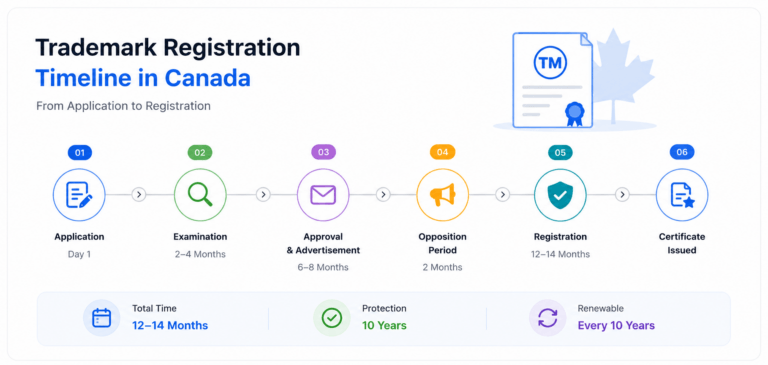
Here’s the actual process, in order:
- Search the trademark registry first. Use CIPO’s Canadian Trademarks Database to check whether your name, or something confusingly similar, is already registered or pending. Skipping this step is the single most common reason applications get refused or opposed later.
- Choose your Nice classes. Trademarks are registered against specific goods and services categories (the international Nice Classification system). A bakery and a software company could both register the same word mark if there’s no overlap in classes.
- File your application through CIPO’s online portal. You’ll need a My ISED Account. Filing online is cheaper than paper filing and CIPO explicitly encourages it. If it is too complicated, use a trusted Canadian trademark agency like Biz Ontario.
- Wait for examination. A CIPO examiner checks your application against the Trademarks Act – for distinctiveness, conflicts with existing marks, and technical compliance.
- Respond to any office actions. If the examiner raises objections, you get a window to respond with arguments or amendments.
- Publication in the Trademarks Journal. Once approved, your mark is published so the public can oppose it if they believe it conflicts with their own rights.
- Registration certificate issued. If no one opposes it (or oppositions are resolved in your favour), CIPO issues your certificate and you officially hold the trademark.
One thing worth knowing from experience: your legal protection is backdated to your original filing date, even though the whole process can take a long time. That timing detail matters if a dispute ever comes up – the date you filed, not the date you got your certificate, is what counts.
🔍 If you'd rather not navigate CIPO's filing portal, examiner objections, and classification rules on your own, Biz Ontario's trademark agents handle the process for you from the initial clearance search through to final registration. Our team has filed and registered more than 1,000 trademarks for Canadian businesses , so we've seen firsthand which applications sail through examination and which ones get flagged - and we build your application to avoid the common pitfalls before CIPO ever sees it. Working with an experienced agent won't change the government's processing timeline, but it significantly reduces the risk of losing your non-refundable filing fee to a preventable rejection or opposition.
How long does Canadian trademark registration actually take?
Realistically, budget for well over a year. As of January 1, 2026, the Canadian government filing fee is $491.06 for the first class and $149.04 for each additional class. But the money isn’t the slow part – the examination queue is.
Processing times reported by practitioners in 2026 range widely depending on whether the application faces objections or opposition, generally somewhere between roughly one and four years from filing to final registration. This is longer than most first-time applicants expect, and it’s a big reason to file as early as possible rather than waiting until your brand has real market traction – you want that early filing date locked in before a competitor gets there first.
What does it cost to register a trademark in Canada?
This is where a lot of confusion comes from online, because people conflate the government fee with the total cost of getting a Canadian trademark filed properly. Here’s the honest breakdown:
| Cost item | Approximate amount (CAD) | Notes |
|---|---|---|
| CIPO filing fee, 1st class | $491.06 | Fees increased 2.7% on January 1, 2026, under the Service Fees Act |
| CIPO filing fee, each additional class | $149.04 | Applies per Nice class beyond the first |
| Renewal fee | Paid every 10 years | No annual maintenance fees for trademarks, unlike patents |
| Trademark agent / lawyer (optional) | Roughly $1,000–$3,000 | Covers search, drafting, and responding to examiner objections |
| Pre-filing clearance search (optional) | Roughly $500–$2,000 | Depends on depth — full common law + registry search vs. basic database check |
A single-class DIY application, if nothing goes wrong, can cost under $500 in government fees alone. But “if nothing goes wrong” is doing a lot of work in that sentence – CIPO does not refund fees if an application is refused, abandoned, or successfully opposed, so a rejected application isn’t just a delay; it’s a sunk cost. That’s the real argument for a proper clearance search before you file, not after.
Where do I search the Canadian trademark registry before applying?
CIPO maintains the Canadian Trademarks Database, which is the authoritative registry for registered and pending trademarks in Canada. It’s free to search, and it’s the first place to check – not NUANS, which is a corporate name search tool used for incorporation, not trademark clearance. Confusing the two is a common and costly mistake: a clean NUANS report tells you nothing about whether your name infringes an existing trademark.
A thorough search also goes beyond the exact name. Examiners and courts look at whether a name is “confusingly similar” – similar sound, similar meaning, or similar overall commercial impression – not just identical spelling. This is why a name search that only checks for exact matches gives a false sense of security.
⚠️ Can someone really steal my business name in Canada?
Yes, in the sense that matters practically: if you haven't registered your name as a trademark, someone else can legally register it first - even if you were using it before them, provided you can't prove sufficient common law rights in a dispute.
Once they hold the registration, they have the stronger legal position , and you may be the one forced to rebrand, not them.
This happens more often in Canada than people expect, particularly with businesses that expand from one province into others. A name that was safe to use locally can become a liability the moment a national competitor with a registered trademark notices the overlap.
Frequently Asked Questions
Does registering my company name with the province protect it like a trademark?
No. Provincial and federal business or corporate registries only prevent identical name duplicates within that specific registry. They do not check trademark databases or grant exclusive commercial rights the way a CIPO trademark registration does.
Can I use the ™ symbol before my trademark is registered?
Yes. The ™ symbol can be used to signal that you're claiming common law rights in a mark, whether it is registered or not. The ® symbol, however, should only be used once CIPO has actually issued your registration certificate.
Does a Canadian trademark registration protect my name in the United States?
No. Intellectual property rights are strictly territorial, so a CIPO registration only protects you within Canada. If you plan to operate in the United States, you need a separate trademark application with the USPTO.
What happens if someone opposes my trademark application?
Your application is published in the Trademarks Journal for a set opposition period, during which anyone who believes your mark conflicts with their existing rights can file a formal opposition. If this happens, you'll need to respond, and it can add significant time and legal cost to the process.
Do I need a lawyer to register a trademark in Canada?
No. You can file directly through CIPO's online portal yourself. That said, given that fees are non-refundable if your application is refused, abandoned, or opposed, many businesses find that a modest upfront investment in a trademark agent reduces the risk of losing the filing fee entirely due to a preventable technical rejection.