


Incorporate a business federally in Canada by filing Articles of Incorporation with Corporations Canada under the Canada Business Corporations Act (CBCA), paying a $200 fee online, and receiving a Certificate of Incorporation – usually within one to two business days. This gives your corporation Canada-wide name protection and the legal right to operate in every province and territory, though you’ll still need to register extra-provincially wherever you actually do business. It’s the structure most founders choose when they plan to scale beyond one province or want the credibility of a “Canada corporation.”
I’ve walked dozens of founders through this decision, and the fastest way to get it wrong is treating federal and provincial incorporation as interchangeable. They’re not. Below is exactly how the process works, what it costs in 2026, and when federal genuinely beats provincial – and when it doesn’t.
What Is Federal Incorporation, Exactly?
Incorporate a business federally in Canada means your corporation exists under the CBCA rather than under a single province’s corporate act (like Ontario’s OBCA or British Columbia’s BCA). Corporations Canada, a branch of Innovation, Science and Economic Development Canada (ISED), administers the CBCA and handles all filings.
Incorporate a business federally in Canada doesn’t automatically licensed to operate everywhere – it just has the right to. You still need to register in each province where you have a physical presence, employees, or are actively soliciting business. That distinction trips up a lot of first-time founders.
What Does It Cost to incorporate a business federally in Canada?
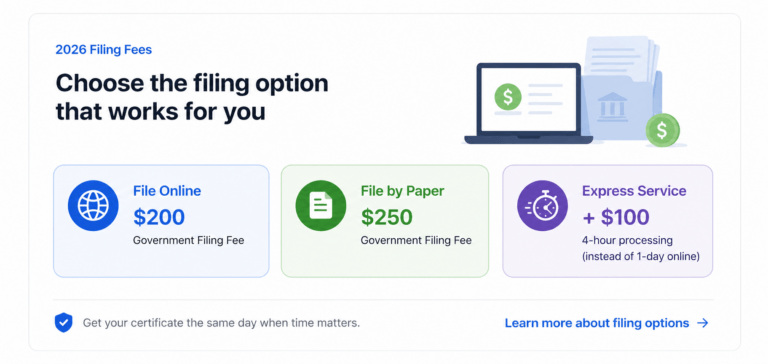
As of 2026, the government filing fee is $200 if you file online, or $250 by paper. Corporations Canada also offers a $100 express service that turns a standard 1-day online filing into a 4-hour one – worth it if you’re closing a bank account or signing a lease and need your certificate same-day.
| Cost item | Federal (CBCA) | Ontario (OBCA) |
|---|---|---|
| Base filing fee (online) | $200 | $300 |
| Paper filing fee | $250 | $300 |
| Express service | +$100 (4 hrs) | Varies by provider |
| NUANS name search | Built into online filing (or ~$60 standalone) | ~$80, required separately |
| Annual return fee | $12/year | Included in registry account |
| Extra-provincial registration (if needed) | Required per province, e.g. ~$330 in Ontario | Not needed within Ontario |
| Director residency | 25% must be Canadian residents | None (removed in 2021) |
Beyond government fees, budget for a lawyer or incorporation service if you want help with share structure and a proper minute book. That typically adds $700–$2,000, though many straightforward incorporations don’t strictly need it.
Can You Incorporate in Canada Online?
Yes - and it's the default path now. Corporations Canada's Online Filing Centre handles the entire process: name search, Articles of Incorporation, director information, and payment. One detail that surprises a lot of people: you no longer need to order a separate NUANS report for a named federal corporation filed online. The corporate name search is built directly into the filing system.
If you want extra certainty before committing to a name, you can still order a standalone NUANS pre-search report (valid for 90 days), but it's optional, not mandatory, for online filings.
Step-by-Step: How to incorporate a business federally in Canada?
- Decide on a named or numbered corporation. A numbered company (e.g., "14582967 Canada Inc.") skips the name search entirely and is the fastest option if branding isn't urgent.
- Run the built-in name search (if going with a named corporation) through the Online Filing Centre.
- Confirm your director slate meets the 25% Canadian-residency rule - or, if you have three or fewer directors, at least one must be a Canadian resident.
- Set your share structure - most small corporations start with a simple single class of common shares.
- File Articles of Incorporation online and pay the $200 fee (or $300 with express service).
- Receive your Certificate of Incorporation - typically within 1 business day, or 4 hours with express service.
- File your Individuals with Significant Control (ISC) register within 30 days of incorporation.
- Register for a CRA Business Number, and open GST/HST, payroll, and corporate tax accounts as needed.
- Register extra-provincially in any province where you'll have a physical office, employees, or ongoing business activity.
- Set up your minute book, issue share certificates, and hold your first organizational meeting to appoint officers.
A Faster Path: Filing Through an Incorporation Agency
The steps above are straightforward on paper, but filing directly with Corporations Canada means you're on your own if something goes wrong - a rejected name, a director residency issue, a missed ISC filing deadline, or another filing error.
Unlike government portals, an experienced incorporation agency provides guidance throughout the process, helping you avoid common mistakes that can delay approval or require costly corrections.
At Biz Ontario, we've helped more than 5,000 businesses incorporate across Canada. We guide clients through name searches, director eligibility, share structure, ISC filings, and extra-provincial registrations - so nothing falls through the cracks and there's always someone to call if your filing needs attention.
Incorporate in Canada Federal vs. Ontario: Which Should You Choose?
This is the question I get asked most, and the honest answer is: it depends on where your customers and operations actually are.
Choose federal if:
- You plan to operate in multiple provinces from day one
- You want nationwide name protection so a competitor in Alberta can’t register the same name
- You’re building toward outside investment or a cross-Canada brand
- You’re comfortable meeting the 25% Canadian-director residency requirement
Choose Ontario (or another province) if:
- Your business is genuinely local – one office, one province, no near-term expansion plans
- You want to avoid the extra step (and cost) of extra-provincial registration
- Your director slate doesn’t meet federal residency requirements (Ontario and BC have no residency rule at all)
One practical wrinkle worth flagging: if you incorporate federally but only ever operate in Ontario, you’ll still need to register extra-provincially with the Ontario Business Registry – which costs roughly $330 and adds a filing step most founders don’t anticipate. In that scenario, you’re effectively paying twice for something a straight Ontario incorporation would have solved in one filing. I generally tell founders: if you can’t name a second province you’ll be doing business in within 12–18 months, provincial is usually the leaner choice.
What Is the ISC Register and Why Does It Matter?
Since January 22, 2024, every CBCA corporation must maintain and file a register of Individuals with Significant Control (ISC) – anyone who owns or controls 25% or more of the corporation’s shares, directly or indirectly. This must be filed within 30 days of incorporation and updated within 15 days of any change. It’s a transparency measure aimed at curbing money laundering and hidden corporate ownership, and Corporations Canada checks for it during routine filings. Skipping this isn’t a minor paperwork gap – non-compliance can affect your corporation’s good standing.
Definitions: Key Terms You’ll Run Into
- CBCA – Canada Business Corporations Act, the federal statute governing federal incorporation.
- NUANS – Newly Upgraded Automated Name Search; the tool used to check whether a proposed corporate name conflicts with existing names or trademarks.
- ISC Register – the record of individuals who own or control 25%+ of a corporation’s shares.
- Extra-provincial registration – the process of registering an out-of-province (or federal) corporation to legally operate in a specific province.
- Numbered company – a corporation identified by a government-assigned number instead of a chosen name (e.g., “14582967 Canada Inc.”).
A Practical Note From Experience
Most founders fixate on the $100 fee difference between federal and Ontario incorporation and miss the bigger cost driver: extra-provincial registration. I’ve seen founders incorporate federally “to keep options open,” then spend the next two years operating solely in one province while quietly paying an annual extra-provincial fee they didn’t need. If national expansion is a real 12–18 month plan rather than a someday-maybe, federal earns its keep. If it isn’t, provincial incorporation is usually the cheaper, simpler call – you can always convert or continue federally later if your footprint grows.
Frequently Asked Questions
How long does it take to incorporate federally in Canada?
Online filings are typically processed within 1 business day. Paying the additional $100 express fee can reduce processing time to about 4 hours for standard filings.
Do I need a lawyer to incorporate federally?
No. You can file directly through the Corporations Canada Online Filing Centre. A lawyer or incorporation service is recommended if you have multiple shareholders, complex share classes, or need a properly drafted shareholders' agreement.
What's the difference between Inc., Ltd., and Corp.?
There is no legal difference. Inc., Ltd., and Corp., along with their French equivalents Ltée and Société par actions de régime fédéral, are interchangeable legal elements used in corporate names. The choice is primarily a branding preference.
Can a non-resident incorporate federally in Canada?
Yes, but at least 25% of directors must be Canadian residents, or at least one director if there are three or fewer directors. Non-residents without qualifying Canadian directors may consider provinces such as British Columbia or Nova Scotia, which do not have a general director residency requirement.
Do I still need extra-provincial registration if I incorporate federally?
Yes, if you have a physical presence, employees, or are actively conducting business in a specific province. Federal incorporation gives you the right to operate nationwide, but each province may still require its own registration and fee, such as Ontario's extra-provincial registration requirements.