


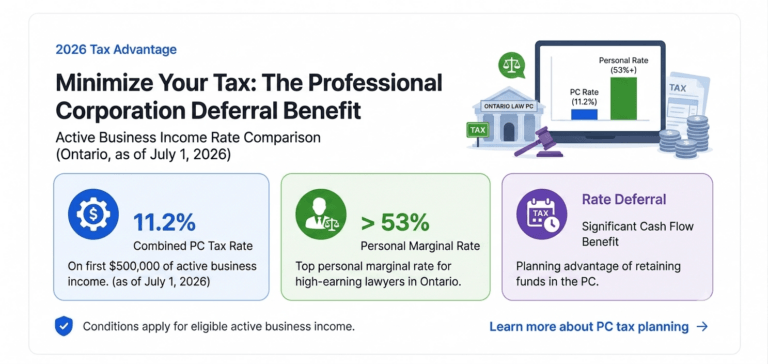
Yes, lawyers in Ontario can save meaningfully on tax by incorporating an Ontario professional corporation (PC), but only on income they leave inside the corporation rather than pay out to themselves personally. The main benefit is rate deferral: active business income earned through a PC is taxed at a combined federal-provincial rate of 11.2% on the first $500,000 (as of July 1, 2026), compared to personal marginal rates that climb above 53% for high-earning lawyers in Ontario. The catch is that this advantage only materializes if you can afford to leave money in the corporation rather than draw it all out as salary or dividends.
This isn’t a loophole – it’s a structure the Law Society of Ontario (LSO) explicitly permits and regulates. But it comes with rules most articles gloss over, and the tax math only works for certain income levels and spending habits.
⚖️ What Is an Ontario Professional Corporation, Exactly?
A Professional Corporation (PC) is a corporation licensed by a professional regulatory body-in this case, the Law Society of Ontario (LSO) - to carry on the practice of law.
Unlike a standard business corporation, a law Professional Corporation can generally only be owned by lawyers or licensed paralegals in good standing with the LSO (subject to limited exceptions allowing certain family members to own non-voting shares). It must also comply with the LSO's Professional Corporations By-Law.
Although the corporation receives client payments and files its own corporate tax return, the lawyer - not the corporation - is legally responsible for providing legal services.
📋 Key Structural Facts
| Feature | Requirement |
|---|---|
| Who Can Own Shares | Only lawyers or licensed paralegals in good standing with the LSO. Certain family members may own non-voting shares. |
| Corporate Name | Must include the lawyer's name and the words "Professional Corporation". |
| Regulatory Body | Law Society of Ontario (Certificate of Authorization required). |
| Professional Liability | A Professional Corporation does not protect lawyers from malpractice or professional negligence claims. |
| Tax Filing | The corporation files its own T2 Corporate Income Tax Return. |
💡 Important Legal Note
Many lawyers mistakenly believe incorporating eliminates personal liability. It doesn't. A Professional Corporation can help protect business assets from certain commercial liabilities and may provide tax-planning opportunities, but it does not shield you from claims arising from professional negligence or malpractice. Your obligations under the Law Society of Ontario - including insurance and professional conduct requirements-continue to apply personally.
How Do Lawyers Actually Save Tax Through a PC?
The savings come from tax deferral, not tax elimination. Here’s the mechanism:
- Your PC earns income from legal fees, minus business expenses (rent, staff, disbursements, etc.).
- The PC pays corporate tax on what’s left – at 11.2% up to $500,000 of active income (as of July 1, 2026), instead of your personal rate.
- You pay yourself only what you need as salary or dividends, which is taxed personally.
- Whatever stays in the corporation keeps growing at the low corporate rate instead of being taxed away at your marginal personal rate immediately.
The deferral advantage disappears the moment you pull the money out personally – you’ll pay top-up personal tax on dividends eventually. The benefit is real only if you can leave surplus income invested inside the PC for years, using it to build a retirement fund, buy investments, or reinvest in the practice.
Note that the lawyers who benefit most from a PC aren’t necessarily the highest billers – they’re the ones with lower personal spending needs relative to their firm income, since that’s the only way retained earnings actually accumulate inside the corporation instead of being drawn out.
What Is the Ontario Professional Corporation Tax Rate in 2026?
Ontario’s small business tax landscape changed mid-year in 2026, so the rate you pay depends on your PC’s fiscal year-end.
Ontario CCPCs pay a combined corporate tax rate of 12.2% on the first $500,000 of active business income – 3.2% provincial plus 9% federal – with income above that threshold taxed at the general combined rate of 26.5%. As of July 1, 2026, Ontario permanently cut the small business tax rate from 3.2% to 2.2%, bringing the combined small business rate down to 11.2%.
For a PC with a fiscal year that straddles that July 1 change date, the rate gets prorated. A corporation with a December 31 year-end must prorate across both periods – the old 3.2% Ontario rate applies to the first half of the year, and the new 2.2% applies to the second half – producing a blended combined rate of approximately 11.7% for 2026, settling at 11.2% from 2027 onward.
Rate summary:
| Income band | Rate before July 1, 2026 | Rate from July 1, 2026 |
|---|---|---|
| First $500,000 (active income, CCPC) | 12.2% (9% federal + 3.2% Ontario) | 11.2% (9% federal + 2.2% Ontario) |
| Above $500,000 | 26.5% (15% federal + 11.5% Ontario) | 26.5% (unchanged) |
| Passive/investment income inside PC | ~50%+ combined | Similar, unaffected by the cut |
Over 375,000 Ontario businesses are expected to benefit from this rate reduction, worth up to $5,000 per year once fully phased in for corporations using the full $500,000 small business limit. For a solo law practice or small partnership operating through PCs, that $5,000 is on top of the deferral advantage already described – it’s a straight-up rate cut, not just timing.
One nuance specific to Ontario worth knowing: Ontario does not apply the federal restriction that reduces the Small Business Deduction once passive investment income exceeds $50,000 – an advantage for CCPCs, including law PCs, that hold investment income inside the corporation. That means a lawyer building a retirement portfolio inside their PC doesn’t lose provincial small-business access the way they might lose the federal deduction.
📋 How Do You Register a Professional Corporation in Ontario?
Registering a law Professional Corporation (PC) is a two-track process. You'll need to work with both the Ontario Business Registry and the Law Society of Ontario (LSO).
⚠️ Most Common Mistake
Many professionals complete the incorporation but forget to obtain their LSO Certificate of Authorization. Without this certificate, your corporation may legally exist, but it cannot practice law or bill clients as a Professional Corporation.
-
Reserve a NUANS Name
Choose a corporate name that includes your legal name and the words "Professional Corporation" (for example, Jane Smith Professional Corporation). -
Incorporate Through Ontario's Business Registry
File your Articles of Incorporation through ServiceOntario or use a lawyer, paralegal, or incorporation service provider. -
Apply for an LSO Certificate of Authorization
Submit the required application to the Law Society of Ontario confirming the corporation complies with all Professional Corporation rules. -
Prepare a Shareholders' Agreement
Ensure voting shares remain restricted to eligible licensees in accordance with LSO by-laws. -
Register for CRA Accounts
Obtain a Business Number (BN) and register for corporate tax, payroll, and HST accounts where applicable. -
Open a Corporate Bank Account
Keep corporate and personal finances separate. Mixing funds can create accounting complications and weaken the intended corporate structure. -
Renew Your LSO Authorization Annually
Your Certificate of Authorization must remain active. Missing renewals can affect your ability to operate and invoice clients through the corporation. -
Allow Time for Processing
Budget approximately $200–$400 in incorporation fees, plus the applicable LSO authorization fee. Most registrations take between 2–6 weeks depending on processing times.
✅ Need Help With the Two-Track Process?
If you'd rather avoid coordinating between multiple government and regulatory bodies, Biz Ontario can manage the entire process from start to finish.
Our team assists with:
💡 Practical Insight
The incorporation filing itself is usually straightforward. The step that most often causes delays is the LSO Certificate of Authorization. Many applicants assume incorporation alone allows them to operate as a Professional Corporation, only to discover later that additional regulatory approval is still required.
Does a Professional Corporation Make Sense for Every Lawyer?
Not necessarily. The math favours PCs for lawyers who bill well above their personal living expenses and can genuinely leave income inside the corporation.
A PC likely helps you if:
- Your firm income significantly exceeds what you need to draw each year personally
- You want to build a corporate investment or retirement portfolio at the lower tax rate
- You’re planning income splitting with a spouse who holds non-voting shares (subject to Tax on Split Income rules)
A PC likely doesn’t help you if:
- You need to withdraw nearly all your billings personally to cover living costs
- Your practice income is modest and doesn’t exceed personal marginal tax thresholds by much
- You’re not prepared to handle the added accounting, filing, and LSO compliance overhead
This is exactly where a lot of generic advice goes wrong – incorporation is marketed as an automatic win, but if you’re drawing out 100% of your billings every year anyway, you get the compliance cost without the deferral benefit.
Frequently Asked Questions
Does incorporating protect a lawyer from malpractice liability?
No. An Ontario professional corporation shields personal assets from general business creditors, but the Law Society of Ontario still holds the individual lawyer personally responsible for professional negligence and misconduct.
Can a lawyer's spouse own shares in an Ontario law PC?
Yes, but only as non-voting shares. Voting control and management must remain with licensed lawyers under the LSO's Ontario Professional Corporations By-Law, and income splitting through dividends to family members is subject to the federal Tax on Split Income (TOSI) rules.
Do I need a separate HST number for my law PC?
Yes, if your PC's annual revenue exceeds $30,000, it must register for and charge HST separately from your personal tax obligations, since the corporation is a distinct legal and tax entity.
What happens to my PC if I let my LSO Certificate of Authorization lapse?
The corporation can lose its authority to provide legal services until the certificate is renewed, which can disrupt billing and client service. It's treated as a compliance failure by the Law Society, not just an administrative delay.
Is the tax savings from a PC guaranteed every year regardless of income level?
No. The 11.2% rate only applies to active business income up to the $500,000 small business limit. Income above that is taxed at the general 26.5% combined rate, so the savings scale down as a percentage once a firm's PC income grows past that threshold.