


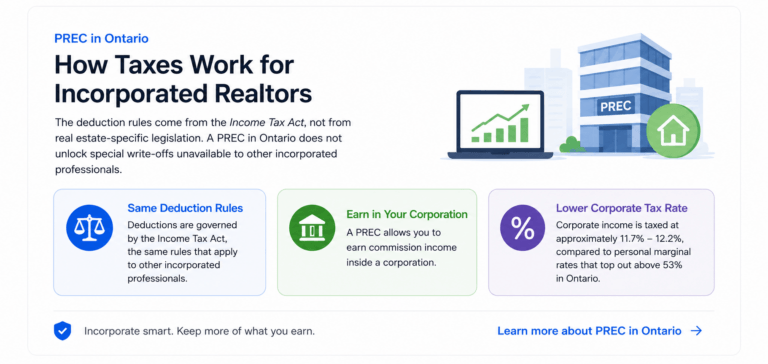
A Personal Real Estate Corporation (PREC) lets an Ontario realtor deduct the same broad category of expenses any active Canadian-Controlled Private Corporation (CCPC) can deduct – vehicle costs, home office use, marketing, licensing fees, professional dues, salaries paid to family members, and more – provided each expense is reasonable and incurred to earn business income. The deduction rules come from the Income Tax Act, not from real estate-specific legislation, so a PREC in Ontario does not unlock special write-offs unavailable to other incorporated professionals. What it does unlock is the ability to earn commission income inside a corporation taxed at roughly 11.7–12.2% instead of a personal marginal rate that tops out above 53% in Ontario.
This article breaks down what qualifies, what doesn’t, and how the incorporation process itself – including PREC name requirements and Articles of Incorporation – shapes what you can later deduct.
How Does a PREC Actually Work?
A PREC in Ontario is a regular corporation that a licensed realtor uses to receive commission income from their brokerage instead of receiving it personally. Ontario allowed this structure starting October 1, 2020, under Ontario Regulation 536/20 made pursuant to the Trust in Real Estate Services Act (TRESA).
The corporation itself is not licensed and is not registered with the Real Estate Council of Ontario (RECO). Only the individual realtor – called the “controlling shareholder” – holds a RECO registration. The PREC’s sole function is to invoice the brokerage and receive the realtor’s earned commissions.
Because the PREC in Ontario is a CCPC like any other, its deductible expenses follow the same test CRA applies to every business: was the expense reasonable, and was it incurred to earn income. That test comes from section 18(1)(a) and section 67 of the Income Tax Act.
💰 What Expenses Can a PREC in Ontario Deduct?
Below are some of the most common business expenses that a Personal Real Estate Corporation (PREC) in Ontario may deduct, provided they are reasonable, properly documented, and incurred to earn business income.
🚗 Vehicle & Travel Expenses
- Fuel, insurance, maintenance, and repairs
- Vehicle lease payments or Capital Cost Allowance (CCA)
- Parking fees and highway tolls for business travel
💡 Maintain a mileage log showing business kilometres versus total kilometres driven each year.
🏡 Home Office Expenses
- Utilities, internet, and property insurance
- Mortgage interest or rent (business-use portion)
- Maintenance and minor repairs
The deductible amount is generally based on the percentage of your home used exclusively or primarily for business purposes.
📢 Marketing & Client Acquisition
- Professional photography, videography, staging, and signage
- Google Ads, Facebook Ads, and other digital advertising
- Business cards, brochures, flyers, and mail campaigns
- Website hosting, CRM software, and marketing subscriptions
- Client appreciation gifts (subject to CRA reasonableness rules)
📜 Licensing, Insurance & Professional Dues
- RECO registration and renewal fees
- Errors & Omissions (E&O) insurance
- Real estate board and MLS membership fees
- Mandatory continuing education courses
👨👩👧 Salaries Paid to Family Members
A PREC may pay a reasonable salary to a spouse or adult child who genuinely performs work such as administration, bookkeeping, or transaction coordination.
The salary must reflect fair market value. CRA may deny deductions for payments that appear to be income splitting without legitimate work performed.
💻 Office Equipment & Software
- Laptops, monitors, printers, and mobile phones
- Office furniture and supplies
- CRM systems and productivity software
- Accounting and bookkeeping software
Higher-value assets are generally claimed through Capital Cost Allowance (CCA) instead of being deducted entirely in the year of purchase.
⚖️ Professional Fees
- Accounting and bookkeeping services
- Legal fees related to your business
- Tax preparation and corporate filings
- Professional incorporation costs for establishing your PREC
💡 Practical Tax Tip
Claiming every possible expense isn't enough - you should also keep organized records, receipts, invoices, mileage logs, and supporting documents. Good bookkeeping not only maximizes legitimate deductions but also makes responding to a CRA review or audit much easier.
What Can a PREC NOT Deduct?
This is where realtors most often trip up, based on the patterns I see reviewing PREC books each spring.
| Expense | Deductible Through a PREC? | Why |
|---|---|---|
| Personal portion of vehicle/home use | No | Only the business-use percentage qualifies |
| Client entertainment/meals | Partially (50%) | Standard CRA meals & entertainment limit applies |
| Fines and penalties | No | Never deductible regardless of business purpose |
| Clothing for showings (non-uniform) | No | CRA treats ordinary clothing as a personal expense |
| Life insurance premiums (in most cases) | No | Only specific collateral-assignment situations qualify |
| Passive investment income earned inside the PREC | Taxed at higher rate, not a deduction issue | Reduces access to the Small Business Deduction once aggregate investment income exceeds $50,000 |
How Much Tax Does Incorporating a PREC Actually Save?
Here’s a comparison using 2026 Ontario rates. A realtor earning $250,000 in commission personally pays combined federal-Ontario tax at marginal rates reaching 53.53% on income above roughly $246,752. That leaves the realtor with somewhere in the $150,000–$165,000 range after tax, depending on RRSP contributions and other personal deductions.
The same $250,000 earned inside a PREC and left in the corporation is taxed at the small business rate – approximately 11.7% for the 2026 calendar year as Ontario’s provincial small business rate drops from 3.2% to 2.2% on July 1, 2026, settling at a combined 11.2% from January 1, 2027 onward. That’s a deferral, not a permanent exemption – you still pay personal tax when you eventually withdraw the funds as salary or dividends – but it lets a realtor retain far more capital inside the corporation for reinvestment, RRSP-style corporate investing, or smoothing income across slow years.
Original insight: In my experience helping realtors set up PRECs, the deferral matters most for agents who don’t need to withdraw every dollar of commission the year they earn it. A realtor coming off a $400,000 year who plans to reinvest in marketing, hire an assistant, or buffer against a slower following year gets far more value from a PREC than one who needs to pull nearly all of it out personally regardless.
🏡 How to Incorporate a PREC in Ontario: Step-by-Step
- Confirm RECO Eligibility - Ensure your RECO registration is active.
- Choose Your Corporate Name - Your name must comply with the Ontario Business Corporations Act (OBCA). Most professionals use "Your Full Name Professional Real Estate Corporation."
- Run a NUANS Search - Confirm your proposed corporate name is available.
- File Articles of Incorporation - Incorporate under the OBCA. The realtor is normally the sole director, officer, and voting shareholder. Non-voting shares may be issued to eligible family members or a family trust.
- Prepare the Required Brokerage Agreement - Create the written agreement between the realtor, the PREC, and the brokerage as required under TRESA.
- Notify RECO - Provide the corporation's legal name and address before commissions can be paid directly to the PREC.
- Open a Corporate Bank Account - Keep business and personal finances completely separate from day one.
- Register with CRA - Apply for a Business Number (BN) and register for GST/HST or payroll accounts if required.
Why Choose Biz Ontario?
Our team can manage the entire incorporation process for you, including:
PREC Ontario Regulations You Need to Know
- Sole controlling shareholder rule: Only one person can hold voting/equity shares – no spouse or partner co-ownership of voting shares, though non-voting shares are allowed.
- No unrelated business activity: A PREC can only provide the controlling shareholder’s real estate trading services. It cannot hold investment property, earn referral fees from other agents outside that structure, or run a side business.
- Remuneration cap: The PREC cannot pay the controlling shareholder more than the brokerage paid the PREC.
- Personal liability remains: Incorporating does not shield a realtor from RECO discipline or professional liability for their conduct as a registrant.
- Governing regulation: Ontario Regulation 536/20, made under TRESA, is the primary source of PREC rules; RECO’s published guidance interprets it in practice.
Frequently Asked Questions
Do I need to register my PREC in Ontario with RECO?
No. The controlling shareholder must be a registered RECO member, but the PREC itself is exempt from separate RECO registration as long as it meets the conditions in Ontario Regulation 536/20 — most importantly, that it only provides the controlling shareholder's services and doesn't advertise itself as a brokerage.
Can my spouse hold shares in my PREC in Ontario?
Yes, but only non-voting shares. Voting and equity shares must be held solely by the licensed realtor who is the controlling shareholder.
Does a PREC reduce my HST obligations?
No. HST registration and remittance requirements are unrelated to whether you're incorporated; they depend on your revenue thresholds under the Excise Tax Act, the same as any other business.
Can I deduct my real estate license renewal fee through my PREC?
Yes. RECO registration, renewal, and required continuing education fees are ordinary deductible business expenses because they're incurred directly to earn business income.
What happens to my PREC if I change brokerages?
The PREC continues to exist, but you need a new written agreement between the PREC, you, and the new brokerage, along with an updated notice to RECO reflecting the change.